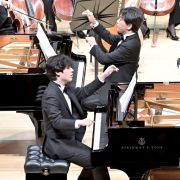
At Seoul Arts Center, Seong-Jin Cho lingered slightly after the opening G major chord of Beethoven’s Fourth Piano Concerto. The phrase that followed seemed absorbed in private thought. Tugan Sokhiev and the Vienna Philharmonic answered in B major, but the piano remained a little apart from the symphonic dialogue. Within a spacious Allegro moderato, the cadenza gave this introspection its widest expressive range. Quiet exchanges gathered momentum; a lucid cantabile darkened briefly into melancholy before passion returned without exaggeration. Cho made these changes feel like developments of the same thought. The line beneath the closing trill kept the phrase moving. When it fell away, the tremor above dwindled to an exquisite pianissimo before the orchestra resumed.


Sokhiev gave the Andante’s string unisons their full severity. Cho waited for those declarations to subside before answering in pianissimo, the lingering resonance between his chords lending the responses a soliloquising character. As the dialogue grew more closely spaced, the orchestra seemed drawn into his quiet inner world. His patience made the reconciliation persuasive. Yet the spacious replies sometimes acquired a self-pitying cast, softening the tension between orchestral resistance and solo entreaty.
Hushed strings set the Rondo in motion with a clear rhythmic impulse, bringing the concerto’s preceding breadth into better proportion. The closing Presto pressed forward, while the sudden withdrawal before the final tutti sharpened the approach to the last chords. Even here, the finale’s exuberance remained just short of abandon.
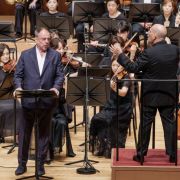
Brahms’ Second Symphony was more compelling. Sokhiev was generous with the lyricism but firm about the symphony’s direction, his freedom with tempo guided by a sure sense of classical proportion. He carried the lullaby-like melody in violas and cellos on a flowing pulse, then broadened markedly for the late horn solo and the ensuing string phrases. This extended leave-taking became a destination in its own right. The movement’s lyrical centre of gravity had shifted towards its close. Short woodwind exchanges and pizzicato strings eventually restored a more articulated motion, bringing the reverie gently to an end.


Successive swellings unsettled the opening cello song in the Adagio non troppo, while the retreats repeatedly prepared further surges. Sokhiev sustained the later climaxes long enough to give those earlier disturbances cumulative weight. When the music subsided, another surge disturbed the quiet. He allowed the unrest time to register, making the movement a substantial emotional counterweight to the first. At the first return in the Allegretto grazioso, the oboe’s dance took on broader phrasing and an affectionate gravity. That slight broadening had changed the character of the theme itself, with the quick episodes sharpening the contrast.
The finale brought a firmer onward drive. Its quiet strings were already alive with movement, an impulse the first tutti enlarged. Sokhiev let the central Tranquillo withdraw deeply before recovering the opening pace at the recapitulation. Vienna’s players followed these changes with a suppleness that kept the generous phrasing connected to the movement’s course. The decisive acceleration came in the coda, carrying the orchestra through to an emphatic close.