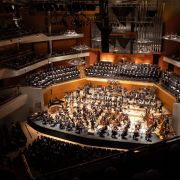
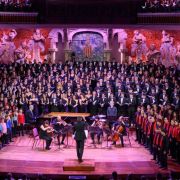
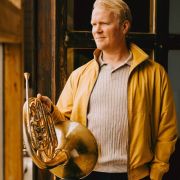
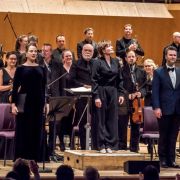
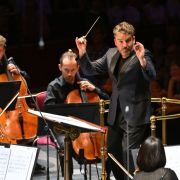
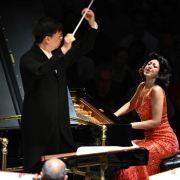
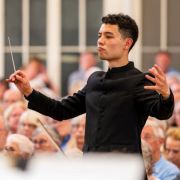
This thoughtfully programmed concert at Manchester’s Bridgewater Hall unfolded as a meditation on questions and responses, intimacy and spectacle. Under the assured direction of John Storgårds, the BBC Philharmonic Orchestra moved seamlessly from the metaphysical stillness of Charles Ives, through the poised lyricism of Beethoven, to the neon-lit exuberance of John Adams’ City Noir.

Taking just a moment, seemingly to concentrate his thoughts, Storgårds lifted his baton and the strings began almost inaudibly, creating a hypnotic, almost mesmerising sound. As the slowly changing chords morphed from one to another, Ives’ The Unanswered Question emerged. The vibrato-less strings, with their purity and perfect intonation, created a magical sound. Interjections from four flutes and the off-stage trumpet did not once detract from this focused, almost metaphysical atmosphere.


Alim Beisembayev replaced Paul Lewis in Beethoven’s Fourth Piano Concerto. The hushed G major chords that ended The Unanswered Question seemed to resonate and respond to the G major chord from the piano that begins Beethoven’s concerto. The three movements were well paced and tempo markings adhered to, without any sense of urgency, especially in the central movement, where haste could easily have rendered the performance bland.
Throughout the concerto, Beisembayev produced a bright tone, contrasting with the softer palette Storgårds cajoled from the orchestra. Articulation was crisp: staccato notes had proper detachment, tenutos a delicate emphasis, and legato a genuine smoothness. Beisembayev’s phrasing was clear – though not always predictable – which made for an engaging interpretation. In the opening Allegro moderato, the development’s minor-key episodes were intense, while the major-key passages offered only momentary relief. This underlying darkness prevailed in the central Andante con moto movement, with its antiphony between strings and piano echoing the preceding exchanges in the Ives. The monophonic strings posed their questions, while the homophonic chords of the piano searched for a different answer each time. The clouds finally dispersed in the concluding Rondo which filled the auditorium with pleasure. To lift the spirits further, Beisembayev offered a Scarlatti encore, brimming with sunshine.


Manchester was treated last autumn to a series of concerts with the Hallé conducted by John Adams, featuring several of his most popular works. In this concert, the city was offered more Adams – this time City Noir (2009). The orchestral forces required for this 35-minute piece are vast: a battery of percussion using nine players, alongside piano, celesta and two harps. Filling the stage – and its extension – Storgårds brought this epic score vividly to life. The three movements — The City and its Double, The Song Is for You and Boulevard Night – are seamlessly joined. Textures and musical styles shift constantly, from watery and flowing to pounding and manic; from jazzy to dissonant; from Stravinsky-like angularity to echoes of Bernstein’s West Side Story, all unmistakably in Adams’ own voice. Storgårds navigated the score’s complexity with precision and authority, rounding off a concert that moved compellingly from introspection to exuberance.