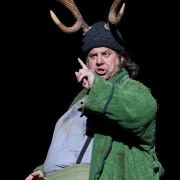
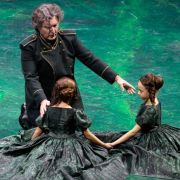
At the Teatro di San Carlo, Werther returns in a production that, even today, retains a rare theatrical intelligence. Willy Decker’s staging, created for the Oper Frankfurt and already known to Neapolitan audiences from a previous San Carlo revival, avoids every trace of decorative Romanticism in favour of something far more unsettling and contemporary. Time has not diminished its impact; on the contrary, the years seem only to have sharpened the lucidity of its vision.

Revived by Stefan Heinrichs, the production strips the opera of its sentimental comfort and places the drama in an almost suspended psychological dimension. Wolfgang Gussmann’s austere sets – sharp geometries, empty spaces, controlled colours – together with Joachim Klein’s cold sculptural lighting create a world already emptied of hope long before the final scene arrives. Everything seems governed by emotional distance: between bodies, between words and feelings, between desire and reality. What emerges is not the conventional portrait of a Romantic hero, but the anatomy of emotional isolation itself.


This is precisely where the production reveals its modernity. Werther is no longer simply the hypersensitive dreamer destroyed by impossible love, but a man incapable of reconciling the absolutism of his emotions with the structures of ordinary life. Charlotte, equally, becomes far more than the unattainable beloved; she is a woman crushed beneath duty, terrified by the possibility that one emotional surrender could destroy the fragile order holding her existence together. The opera suddenly feels disturbingly close to our own age.

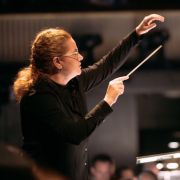
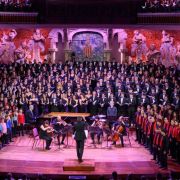
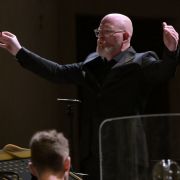
In the pit, Lorenzo Passerini approached the score with elegance and restraint, refusing all unnecessary pathos. His reading privileged transparency, allowing Jules Massenet’s orchestration to breathe naturally while maintaining a constant dramatic pulse. The San Carlo Orchestra responded with admirable precision and flexibility, always attentive to the vocal line and to the intimate theatrical rhythm of the work itself.
At the centre of the evening stood Francesco Demuro, delivering a Werther of remarkable emotional intelligence. What made his interpretation convincing was precisely its refusal of excess. Demuro never indulged in easy despair; instead, he built the role through subtle phrasing, carefully shaded dynamics, and an almost painful inward tension. His Werther seemed consumed less by passion itself than by the impossibility of translating feeling into life. In this context, “Pourquoi me réveiller?” arrived not as a showpiece but as the inevitable emotional fracture point of the entire performance, provoking one of those increasingly rare moments of genuinely spontaneous audience response.
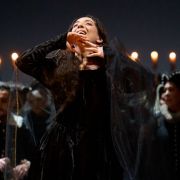
Caterina Piva's Charlotte was equally compelling, avoiding melodramatic rigidity in favour of a deeply human restraint. Her final scenes achieved their emotional impact precisely through measure rather than excess. Alongside her, Désirée Giove offered a luminous Sophie whose freshness served as an essential counterbalance to the drama's growing darkness.


The supporting cast, including Lodovico Filippo Ravizza as Albert and Sergio Vitale as Le Bailli, integrated seamlessly into the severe coherence of the production, while the Children’s Chorus of the San Carlo, prepared by Stefania Rinaldi, proved especially effective, functioning not as a decorative presence but as an almost cruel reminder of innocence and emotional normality lost forever.
Perhaps the most striking achievement of the evening, however, was its refusal of theatrical manipulation. There were no forced climaxes, no superficial emotional shortcuts, no search for immediate effect. Instead, the performance unfolded with a quiet but inexorable inevitability, drawing the audience into an increasingly empty emotional landscape until the final collapse became unavoidable. The silence that accompanied much of the performance inside the San Carlo spoke almost as eloquently as the long applause that followed it. This was not a Werther interested in comforting the audience with Romantic nostalgia; it was a Werther that exposed, with unsettling clarity, the fragility and solitude hidden beneath emotional absolutism.