Verdi’s Falstaff has a close-knit relationship with the Teatro Costanzi, which hosted the first performances following the premiere run at La Scala, in the presence of the composer himself in 1893. Verdi was approaching 80 and he was welcomed in Rome like a national monument on the occasion of the staging of what turned out to be his very last opera. Since then, the work has constantly been present on the theatre’s billboard. Perhaps this particular link to the opera explained the atmosphere of high profile feel at the first night of this new staging, completely overshadowing the Figaro staged last month (although that was a revival), as if it were some minor opera, raising the curious question about the preferences of audiences in the capital.

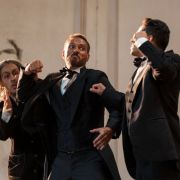
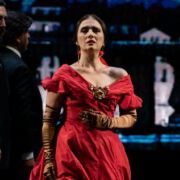
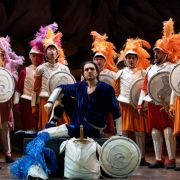
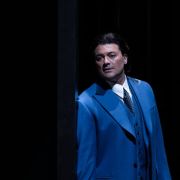
Falstaff is not a ‘popular’ opera, mostly devoid as it is of hit tunes and the pathos which are the trademark of Verdi’s repertoire. It is a masterpiece, but of the intellectual type. German director Tatjana Gürbaca leverages this eminent quality for the concept behind her staging, which veers towards the abstract and the symbolic. The action is moved to an undefined contemporary time, with the colourful costumes by Silke Willrett reminiscent of the 1960s and the set by Henrik Ahr recalling the metaphysical, arcade bordered squares of De Chirico, but all dark and grey. The Garter Inn becomes the Hotel Milano in a metatheatrical reference to both the hotel where Verdi stayed during the premiere of his opera at La Scala and the Scapigliatura artistic movement (of which librettist Arrigo Boito was part), with its centre in Milan.


Doing without a more realistic and identifiable background – of whatever epoch – ends up flattening the contrasts and the social satire that the story wants to highlight: the rise of a rich bourgeoisie versus a decaying aristocracy. More generally, without troubling Aristotle, a certain level of identification with the story on stage always helps the theatre experience. Very little in Gürbaca’s direction facilitates the involvement of the audience. Stefan Bolliger’s lighting doesn’t lift the overall impression of the ‘flatness’ of the show. The final scene in the forest reaches a school play low with the rough costumes and make up of the fairies, who here become witches and display a banner with the feminist Italian slogan “Tremate, tremate, le streghe son tornate” (“Tremble, tremble, the witches are back”), a redundant underlining of the superior power women wield in Verdi’s comedy.

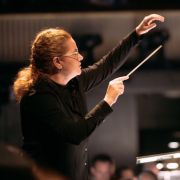
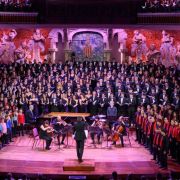
The musical performances was left to do the heavy lifting. Michele Mariotti conducted the Orchestra Del Teatro dell’Opera di Roma with sureness and great effect in the challenging score, an ingenious pastiche of musical styles and references, from the most agitated moments to the ones that required subtlety. The vocal cast were very good. Luca Salsi was a thunderously convincing Falstaff. He has a powerful baritone and a confident stage presence, albeit lacking some colour and he was uncomfortable with the falsetto required by some brief passages. George Petean was a brilliant Ford, providing an interesting contrast with Salsi with his rounder, more ringing baritone. The scene where he visits Falstaff dressed up as the rich Fontana in a red tennis outfit was a highlight of the show.


Soprano Maria Agresta was a reliable Alice Ford and mezzo-soprano Carmen Artaza a nice Meg Page. Dramatic mezzo Violeta Urmana lent all of her experience and comic gravitas to Mistress Quickly. Soprano Marina Monzò (Nannetta) left an impression with her malleable voice and sweet timbre in her duets with Fenton and in her Act 3 aria. Dave Monaco’s Fenton raised the romantic temperature of the evening with his shimmering lyric tenor: a Rossini character transplanted into a Verdi opera. The supporting characters of Cajus (Carlo Bosi), Bardolfo (Paolo Antognetti) and Pistola (Gabriele Sagona) were also all well chosen.

There are instances where a modern staging of an opera makes sense, even a lot of sense; others where it only betrays either a lack of inspiration or a cost-saving trick, but none of which are justified in such a (publicly) well-funded theatre like the Teatro dell'Opera di Roma.