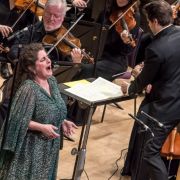
Myths, legends, landscapes and the beyond shaped an evocative evening from the BBC Philharmonic Orchestra at Bridgewater Hall under guest conductor Nicholas Carter. From the opening bars of Wagner’s Prelude to Tristan und Isolde, the atmosphere was one of hushed anticipation. The first phrases unfolded with mellow melancholy before gradually warming, the sound expanding until the orchestra seemed to envelop the hall in a glowing haze. In the final moments, soprano Sarah Wegener entered almost imperceptibly as an almost breathless stillness filled the auditorium.

Wegener’s performance of the Liebestod was a thing of beauty. Confident and assured, she commanded the stage with a presence that felt more dramatic than purely concert-like. Her interpretation brought vivid characterisation, the ascent towards the climactic peak carefully measured and what followed was a transformation of colour, passion giving way to tragedy and longing. The interplay between orchestral phrases and Wegener’s vocal line dovetailed seamlessly, creating a gentle, rocking motion through the score. Her diction was immaculate and her voice possessed both warmth and richness; throughout, she appeared completely immersed in Wagner’s sound world.
The UK premiere of Edmund Finnis’ The Landscape Awakes followed. This cinematic orchestral rhapsody of about 11 minutes, is strikingly accessible, written largely in a tonal language where modal melodies shift fluidly between major, minor and more ambiguous shades. At moments one could hear echoes of Elgar and Vaughan Williams. Finnis notes in the programme that the work is not tied to a specific place but instead evokes “the waking, the dawning, the renewal” that is perpetual in nature, and the music unfolds in a sequence of clearly defined episodes reflecting that idea. Carter and the BBC Philharmonic shaped the textures with clarity and precision, allowing the colours of the orchestra to emerge vividly. The work closes with a tolling bell, a gesture reminiscent of Cantus in Memoriam Benjamin Britten, bringing the piece to a quiet and reflective conclusion.
After the interval came Arnold Bax’s tone poem Tintagel, returning the programme to the world of Wagner through its subtle reference to Tristan und Isolde. Carter vividly conjured the image of a castle rising above turbulent seas – not unlike the vision of Debussy’s mythical cathedral of Ys. The music alternates between passages of imposing grandeur and moments of lyrical delicacy. At times the full orchestral force tipped toward the thunderous, a reminder that a large orchestra does not always need to play at full power, yet the quieter episodes were carefully handled.
Wegener returned to close the evening with Richard Strauss’ Four Last Songs, delivered in a markedly different style from the Wagner. Here there was greater restraint, though no less colour in the voice. Her diction remained pristine, while the vibrato was more prominent, lending a sense of maturity and reflection. Where the Wagner suggested youthful ardour, these songs seemed introspective, almost like a retrospective glance over a lifetime.
Frühling unfolded with a dark, measured pacing that emphasised its narrative quality. In September, Carter balanced the string writing so that individual lines were clearly heard, enriching the orchestral texture beneath Wegener’s poetic delivery. Beim Schlafengehen proved deeply moving, enhanced by a beautifully shaped violin solo from guest leader Lucy Gould. The final song, Im Abendrot, achieved a sense of transcendence.