The final concert of Seattle Chamber Music Society’s 2026 Summer Festival capped an unusually eventful stretch. Owing to summer renovations at Benaroya Hall, its usual venue, the organisation found a number of alternate spaces to perform in, while also expanding its reach through free events in parks and other public spaces across the region. Alongside the launch of a new in-house recording label, SCMS recently announced plans to build an intimate, 271-seat downtown venue dedicated to chamber music, set to open in 2028.

For the closing programme, SCMS filled the atmospheric, 857-seat Great Hall at Town Hall Seattle, presenting an afternoon of familiar composers in less-familiar configurations. Shostakovich’s rarely encountered Prelude and Scherzo for string octet, Op.11, comprise two compact movements originally envisaged as part of a larger string-octet project. Coming after the sizzling account of Mendelssohn’s Octet on opening night, the Shostakovich made a striking bookend: another teenage composer writing for eight strings, though here the result is far more condensed and fragmentary than young Felix’s finished epic.
Composed while the precocious teen was also at work on his ambitious First Symphony, this fascinating diptych came across as wonderfully unruly and thrillingly strange: vigorous unisons, abrupt turns, enigmatic harmonies and, in the Scherzo, an energy mounting toward wild frenzy. Shostakovich’s signature voice already begins to emerge in the hard-driving Scherzo, which he reportedly characterised at the time as “the very best thing I have written”.
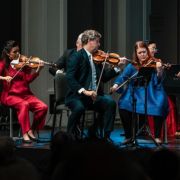
It was fascinating to see artistic director James Ehnes take one of the viola parts, embedded in the middle of the sonority rather than leading from the top, while Karen Gomyo took brilliant charge of the high-flying first violin line. All eight players together brought out the pieces’ startling originality – hardly juvenilia, but instead an early warning flare. It was exactly the kind of seldom-performed score that shows Ehnes’s programming instinct at its best.
While Grieg’s Cello Sonata in A minor has a firm place in the repertory, Chicago Symphony assistant principal cellist Kenneth Olsen and George Li were both performing it for the first time – even though their intense rapport suggested otherwise. Li had already appeared in a free pre-concert recital devoted to Mussorgsky’s original piano version of Pictures at an Exhibition: magnificent and vividly cinematic. In Grieg’s only sonata for the cello – which the composer once performed with Pablo Casals – Li’s passionate keyboard opening found a natural foil in Olsen’s rich, full Stradivarius tone, the cello seeming to steady the music’s surge with lyrical dreaminess. Their exchange suggested something of a Schumannesque Florestan-and-Eusebius pairing: impetuousness answered by inwardness.

After intermission, 13 musicians – four of them Seattle Symphony principals – took the stage for Copland’s complete Appalachian Spring in its original 1944 scoring. This was not the familiar orchestral suite in reduced dress, but the full ballet score as written for Martha Graham and the confined space of the Library of Congress’s Coolidge Auditorium stage.
The lean textures gave the music a different kind of freshness: piano, winds and strings enveloped one another, yet each instrumental colour kept its own glow, with Demarre McGill’s flute, Benjamin Lulich’s clarinet and Seth Krimsky’s bassoon adding much of the performance’s character. Even without a conductor, the ensemble achieved an impressive unanimity, giving the long opening sequence breadth without slack and bringing rhythmic incisiveness to the down-home dance scenes. By the end, Copland’s sense of a future still to be built had become genuinely moving – a fitting close for an organisation already imagining its next home.