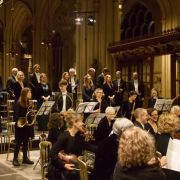
Bath’s prestigious BachFest, now in its 15th annual iteration, is a concentrated midwinter set of performances aiming to be “a celebration of JS Bach and his contemporaries”. Its Artistic Director from this year is Adrian Brendel, who made a short speech of welcome and who dedicated the occasion to his distinguished predecessor Amelia Freedman, who died last year. He offered a programme here which surely would have delighted her, with Bach framing music by Gluck. So we had a musician whose work was heard in church and chamber, sandwiching one whose glories were heard on the operatic stage. And to perform it all we had no less an ensemble than The Sixteen Choir and Orchestra under their founder and conductor, Harry Christophers.

The cantata Darzu ist erschienen der Sohn Gottes, BWV40, was Bach’s first Christmas cantata for his new church in Leipzig in 1723. It must have made the congregation sit up for it features a stirringly festive opening chorus (as so often in Bach). The splendid Bath Abbey location and the sell-out audience deserved no less. The Sixteen Choir (18 singers on this occasion) sang splendidly, with a pair of natural horns braying out to reinforce the exuberance. Tenor Jeremy Budd, baritone Ben Davies and alto Elizabeth Paul, a young and impressive trio, made much of their eloquent solos.
If you are the meat in a Bach sandwich, only your best fare will avoid leaving an audience relatively undernourished. So it was that Gluck was represented entirely by his most performed opera Orfeo ed Euridice. The fine short Act 2 was given before the interval and music from Act 3 after it. The ballet music from that act is unremarkable, but the players of The Sixteen made as good a case for it as only such stylish playing can. And we ended, of course, with Orfeo’s lament after he has mislaid his beloved Euridice for the second time, “Che faro senza Euridice?”, the best opera aria of the whole 18th century possibly, even including Mozart. (Don’t write in.) Wherever you place it in that hierarchy, it had splendid advocacy from mezzo-soprano Heather Lowe.

Bach’s so-called Lutheran Masses, such as that in F major, BWV 233, which closed the concert, are short, setting just the Kyrie and Gloria texts. That still leaves room in the Gloria for three solo arias, for baritone, alto and soprano, for which Alexandra Kidgell was added to the earlier cantata line-up, singing delightfully her Qui tollis peccata mundi. Bach did not like to have a good piece heard just once, so he often recycled (“parodied” in Baroque music parlance) parts of his earlier music for a new text, as here in the final Cum sancto spirito, which is a parody of the chorus that opened Cantata BWV 40, heard at the start of the concert, thus forming an ideal conclusion.
Large ecclesiastical buildings, with their hard surfaces and long high naves, are challenging for complex music like Bach’s. Reverberation means It can be resounding in the wrong sense. An entry in a contrapuntal passage soars aloft and collides with the echo of its predecessor coming down, impairing clarity. Yet the sound is also atmospheric in these places for which the music was intended. Balancing all this seems second nature to Harry Christophers, who has been offering this repertoire in these buildings for nearly 50 years. So here, even if not every line was heard in perfect relation to the others, the atmosphere and exhilaration of the music was terrifically present.
Roy’s visit to Bath was partially funded by Bath Bachfest