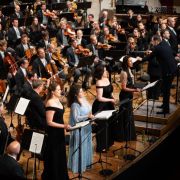
You can forgo your usual Sunday morning espresso if confronted by Mahler’s Eighth Symphony early enough in the day. The blast of the opening E flat major organ chord is guaranteed to rouse even the sleepiest matinee audience. The crowd in the packed Konzerthaus, gathered to hear the final instalment in Andris Nelsons’ Mahler symphony cycle with the Vienna Philharmonic, was duly pumped with a musical caffeine shot.

These days, Mahler symphonies are ubiquitous in concert seasons, but the Eighth comes around rarely enough for it to still feel like an event. Its “Symphony of a Thousand” moniker, which the composer hated, was coined by impresario Emil Gutmann as a marketing stunt for the 1910 premiere in Munich where, indeed, 1030 people participated. Rather fewer – 371 – took part here; still a large enough number to make performances a logistical nightmare, with the Wiener Singverein amassed behind the orchestra on the left, the Wiener Singakademie on the right and the Vienna Boys’ Choir in their sailor suits flanking the organ console.
Add eight soloists into the equation plus the extra brass playing from the eaves above the stage, conducting Mahler 8 is like being a traffic policeman. All Nelsons needed was a pair of white gloves. Instead, a sturdy baton and careful cueing avoided any undue collisions. Nelsons’ direction was purposeful, keeping all his plates spinning. The exception was the hushed orchestral introduction to Part 2, the one part of the work when you can hear the rustling echoes of Mahler’s Wunderhorn symphonies. Here, he lingered atmospherically, relishing the Vienna Phil’s warm halo of string tone as Mahler introduces the mountain gorges that usher in his gargantuan setting of the finale of Goethe’s Faust.

It’s a lop-sided work, but Nelsons made its two unequal parts feel coherently whole. The 8th-century Christian hymn Veni, creator spiritus – part of the Pentecost liturgy marking the descent of the Holy Ghost upon the disciples – sounded duly ecstatic, the three choirs providing an overwhelming wall of sound. The much longer Part 2, where Mahler eschews the best bits of Faust – what, no Mephisto? – can drag, a procession of figures welcoming Faust into heaven. A lot depends on the soloists and here, Nelsons’ team enjoyed mixed success. On the plus side, bass Tareq Nazmi’s authoritative Pater Profundus, Beth Taylor’s rich-voiced Mulier Samaritana and Jacquelyn Wagner’s effortless, gleaming high notes as Magna Peccatrix. Best of all was Ying Fang, floating her few lines as the Mater Gloriosa with pearly radiance from high above the stage.

Less successful were Sarah Wegener as a gentle, if breathy, Penitent, Tamara Mumford’s pale mezzo as Maria Aegyptiaca and Michael Nagy’s Pater Ecstaticus, hurling out his text in ungainly fashion. Tenor Benjamin Bruns sang a hectoring Doctor Marianus, better when singing softly.
All three choirs were outstanding though. The Chorus Mysticus finale, as Faust is redeemed, was shattering, choirs praising the Eternal Feminine (“Ewig-Weibliche”), organ pedal rumbling, brass and tam-tam pealing. Definitely not your usual Sunday morning.