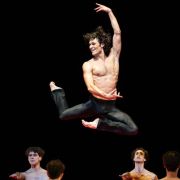
Hugo Marchand, global superstar of Paris Opera Ballet, brought nostalgia to New York City Center in a program of 20th century ballets mostly by European choreographers too rarely seen stateside. Anchored by Maurice Béjart's high-octane Boléro (1961) and revolutionary Firebird (1970), the show drew firepower from four Paris Opera étoiles, a commanding Béjart Ballet Lausanne ensemble, and Paris Opera pianist Elena Bonnay, whose expressive playing in George Balanchine’s Sonatine and Hans van Manen's Trois Gnossiennes spun enchantment.

The intimate City Center suited the program perfectly: close enough to catch the jeweled precision of French style, hear the dancers breathe, and watch emotion flicker across their faces. The stage was so small that had Marchand slipped off Boléro’s iconic red table, he'd have landed in our laps. That intimacy heightened the visceral charge of Boléro’s convulsing torsos and rocking pelvises, and of Firebird’s restless citizens’ resistance known as the Partisans. We missed a live orchestra for the two showstoppers, but the recordings were excellent.

Ravel framed the evening in two very different idioms: the sparkling impressionism of Sonatine against the almost anti-melodic orchestral experiment of Boléro. In the first, the music's riffling cascade spurred Léonore Baulac and Germain Louvet to trade glances, as if asking, ‘Shall we traipse enchantingly across this field together?’ Created by Balanchine on French dancers Violette Verdy and Jean-Pierre Bonnefoux, this gem brims with courtly manners, crystalline pointe work, unusual promenade handholds and swift changes of direction, as if the dancers were wafted by strong breezes. Tender partnering turned mysterious when Baulac led Louvet into the wings: two bodies arched in backbend, making a single curve with hands joined overhead. Ravel’s driving finale sent them whipping through turning leaps in opposite directions, like counter-spinning vortices.

The odd, sometimes witty manipulations of a woman by a man in van Manen's Trois Gnossiennes – as if she were a piece of furniture – could read as a cynical nod to ballet's objectification. Particularly when Marchand marched around with Baulac suspended overhead in the angular shape of a chair. But this pair revealed an otherworldly beauty in their combined movements, taut and pristine. She stared coolly at him and dug a flexed foot into his hand to propel her through space.

Boléro brought down the house at evening’s end. It always does. Ravel reportedly drew inspiration for the score from a visit to Detroit's Ford factory, delighting in its mechanical cacophony and explosive, insistent rhythms. Béjart called his ballet « une histoire de désir ». Today, its sinuous provocations – embodied by a male or female soloist whipping up an ensemble of either sex – can just as easily evoke warmongers, cult leaders, or TikTok influencers. Marchand stayed precise and controlled through the crashing finale, where other soloists have erupted in fury or seemed to end in ritual sacrifice. He pounded the red table like a politician, unfurled eagle-like arms, contorted his torso exquisitely, and punctuated the seduction with tours en l'air and explosive hitch-kicks, daring the men of Béjart Ballet Lausanne – slumped in their chairs – to invade a neighboring country. Gradually, they complied, demonstrating their preparedness with rippling biceps, sexy lunges and a slow descent into pistol squats with arms linked in a show of brotherhood.

Firebird, by contrast, is grounded in classical technique, inspired by the May ’68 protests and Europe's anti-authoritarian ferment. From the ranks of the ensemble, soberly uniformed, emerged Béjart dancer Konosuke Takeoka to dance the Firebird in a scarlet unitard with a cutout at the chest. Crisply beaten jumps and airy, suspended leaps devolved into brittle, jagged moves as this revolutionary leader succumbed in battle. An identically clad Phoenix – a stunning turn by Zsolt Kovacs, bounding with great power – heralded the rebirth of the Firebird's youthful idealism. Scattered crucifixion imagery and hints of mudra – like outstretched arms with hands cupped and joined at the wrists – jumbled Christian, Hindu and Buddhist iconography with Marxist messaging. Admirable, moving performances saved this from kitsch.

One piece New Yorkers did get an up-close look at recently, in this same venue, is the duet from Angelin Preljocaj's Le Parc, famous for the flying, vacuum-sealed kiss, danced then by Marchand and Hannah O'Neill. This time, the luminous Dorothée Gilbert appeared in déshabillé, nuzzling Marchand in 18th-century linen drawers and trading mysterious gestures. Are these repeated teasers a prelude to a full New York revival of this beguiling work?
L'esprit du Bleu, excerpted from Carolyn Carlson's 1997 cult landmark Signes, reminded us what we’ve been spared all these years. Gilbert and Louvet brought all the drama they could muster, and her dress, mimicking water in swirling eddies, was sensational – but neither could rise above the noodling score and vapid gestures. In an evening of bold, sensuous statements and filigreed invention, L'esprit du Bleu flatlined.