If you’ve seen the trailers for Christopher Nolan’s upcoming epic movie of The Odyssey, you can be sure that John Caird’s new Garsington production of Il ritorno d’Ulisse in patria looks nothing like it whatsoever. But of course, it’s the same story (although Monteverdi only covers the last part, from Homer’s Book 13 onwards, when Odysseus washes up asleep on Ithaca) and both Nolan and Monteverdi will have legitimate grounds to believe that the vast majority of their audience know exactly what happens, in a considerable level of detail.

Il ritorno d’Ulisse, therefore, works less as a piece of music drama – there isn’t a cliffhanger in sight – and more as a Renaissance court entertainment, a series of interleaved vocal numbers and dances, each of which enlightens the characters in the story. Many of the numbers are there to elicit sympathy with protagonists, some are genuinely dramatic (even if you know what’s about to happen), some are pastoral, some provide comic relief. What makes the work so special is that Monteverdi was an absolute master of the madrigal, and time after time, the music knocks your socks off.

That’s especially the case when it’s played at the level it was last night, by Laurence Cummings and The English Concert. The viola da gamba and pair of theorbos provided not just a platform but the heart of a whole sound world that transported you to a 17th-century court; cornets, sackbuts and medieval drums lent a festive air, recorders added vivid pastoral colour. Cummings drove the action forward with his and Christopher Bucknall’s harpsichords, or slowed it down from a chamber organ.

Early as Monteverdi was in the history of opera and art song, it bears debate as to whether he was ever surpassed as a composer who could use the human voice to give a direct injection of its characters’ emotions, and last night’s cast made an eloquent case for Monteverdi’s place in the all time hall of fame. Cecelia Hall melted the heart with Penelope’s plea for her husband to return, with its haunting refrain “Torna, deh, torna Ulisse”. Rowan Pierce and Innocent Masuku provided youthful vocal glitter as the lovers Melanto and Eurimaco. In the title role, Ed Lyon was as convincing in his heroic fury at the end as he was in his arousal from sleep (“Dormo ancora o son desto”) at the beginning. James Creswell offered some properly awesome basso profondo singing, plumbing untold oceanic depths as Neptune. The list goes on: even the Shakespearian comic relief character of Iro turned into a highlight in the hands of Stuart Jackson; Claire Lees was a delightful if surprisingly girlish Minerva. I can’t name-check everyone, but they all deserve it.

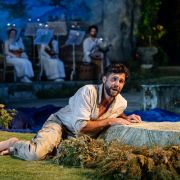
Director John Caird’s and designer Robert Jones essentially re-run their staging of Garsington’s award-winning L’Orfeo from 2022: the musicians flanking the stage on risers, a large circular ring lamp angled in various ways to provide various effects. The overall aesthetic of white, cream and gold costumes is attractive. There are some exceptionally effective low-budget stage magic in the shape of a single huge piece of dark blue cloth which serves either as Penelope’s shift (that she never ceases weaving) or as the billowing sea in which the Faeci carrying Ulysses are adrift. More simple but clever stage tricks create Minerva’s chariot, Ulysses’ transformation from beggar to hero, the lethal archery contest.

I have two caveats. Mesmerising as each individual musical number is – and there were really very few lapses in this – at a full three hours of music, the opera feels long, and I wouldn’t have been averse to a bit of judicious pruning. And you do have to put up with a certain amount of Italian Renaissance nonsense: I doubt that the idea that the life of a poor shepherd was easier than that of an overwrought king would have resonated with the average poor shepherd, whether in the Homeric era or the Renaissance. The libretto has other examples, but they pale into insignificance compared to the number of times that we share in the characters’ hopes, fears, grief or laughter.

As an encore, the company reprised what they sang after L’Orfeo, the madrigal Che dar piú vi poss'io? (“What more can I give you?”), every bit as magically as four years ago. The answer, in this case, is the third extant Monteverdi opera, L’incoronazione di Poppea, which is promised for 2028. I can’t wait.