How difficult must it be to perform La traviata – one of the most famous and beloved operas – knowing that a good percentage of the audience will know each line of it by heart? The anxiety must be almost equal to that of the audience, afraid to spoil the memory of a favourite, close-to-perfect recording.

Sofia Coppola’s lavish production, produced by Valentino Garavani and Giancarlo Giammetti in 2016 for the Teatro dell’Opera di Roma, has since received many revivals and has even travelled twice to Japan. Its beautiful sets were designed by Nathan Crowley and, indeed, the visual side is stunning, the general aesthetic spot on, with its period style brushed up with a touch of modernity. Crowley’s grand sets are memorable in each act, from the Parisian interiors of glass doors, chandeliers and boiserie to the beautiful countryside setting, with a huge conservatory overlooking the Provencal landscape, reproduced on the impressive led screen by Officine K.


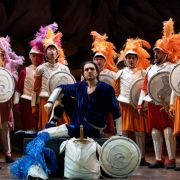
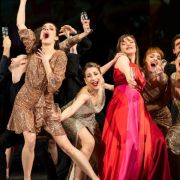
Naturally, Valentino’s costumes for Violetta are beautiful. Perhaps I would have swapped the black dress in Act 1 with the showstopping red dress – symbol of love and passion – of Act 2. The costumes for the rest of the cast and the chorus were by Maria Grazia Chiuri and Pierpaolo Piccioli, colourful in Act 1, all black in Act 2. Although this serves to reflect the different moods of the story – joyful and carefree first, dramatic later – it is a pity that the dancing gipsies (with choreography by Stéphane Phavorin) wear all black costumes, flattening the scene a bit. That said, the dancing, accompanied by the chorus, was one of the most powerful moments of the night.
Coppola, daughter of Francis Ford Coppola, is best known as a movie director and her direction here is traditional. Marina Bianchi collaborated with Coppola in the original direction, which, on this occasion, revived here by Arianna Salzano. Perhaps some details might have been ‘lost in translation’, as occasionally there was a mismatch between words and stage action, notably in Act 3 (Germont realising that Violetta is dying but not looking at her; Violetta talking about her picture in a medallion but not showing the picture straight away).

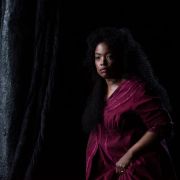
Conductor Francesco Ivan Ciampa delivered an impeccable reading of Verdi’s score and moulded it on the singers. After performing the role of Violetta over 300 times, soprano Ermonela Jaho announced this run would be her last. She sang with consummate experience and intelligence, overcompensating her weaknesses with her strengths, bending the music to her will, emphasising acting over bel canto, with one cough too many and no E flat at the end of “Sempre libera”. But, to quote Oscar Wilde, “to be natural is such a very difficult pose to keep up.” Jaho’s performance ended up looking too artificial for “naturalness”, and the spell didn’t always work. At the end of the day, opera needs the voice above anything else.


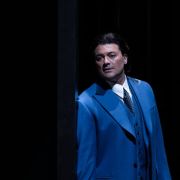
At the other end of the spectrum, tenor Dmitry Korchak let his voice do all the acting for the role of Alfredo. Through the sheer sweetness and fullness of his timbre, he conveyed all the passion of youth, while his sensitive phrasing delivered the drama. Similarly relying on his exceptional vocal abilities was baritone Amartuvshin Enkhbat, who played Germont with the biggest and deepest of voices, a true Verdi baritone; although his static and almost hieratic stage presence – unjustly – distracted from his merits. The reliable Chorus of the Teatro dell’Opera di Roma, prepared by Ciro Visco, was also a real protagonist of the evening.
The singers of the Young Artist Program “Fabbrica” all shone in their secondary roles: mezzo-soprano Maria Elena Pepi as a very elegant Flora, Sofia Barbashova as the faithful maid Annina, baritone Alejo Álvarez Castillo as an assured Marchese d’Obigny and tenor Guangwei Yao as an incisive Gastone.