John Neumeier’s take on the traditional tale of Cinderella for Hamburg Ballet was a deliberate attempt to break free from the classic fairytale when it first premiered in 1992. Neumeier describes this as a more adult interpretation with more depth and emotional intensity. He also acknowledges his production needed an alternative name to differentiate itself, hence A Cinderella Story, however this name doesn't distance itself enough. The audience is still full of families and little girls expecting magic which is sadly lacking in a rather drab production, save for a couple of more sparkling moments.

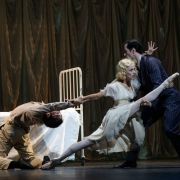
Jürgen Rose’s staging is striking in its minimalism. A monochrome colour palette with contrasting brightly coloured costumes throughout. We begin at Cinderella’s mother’s funeral, all figures in dark silhouette, as they stagger to the burial, limbs rigid and stony faced. Later at the family home, the stage is a clinical white with sparse furniture. Cinderella’s stepmother (Futaba Ishizaki) and stepsisters (Olivia Betteridge and Ana Torrequebrada) fill the stage with their exuberant presence, pink and orange ruffles for the sisters and a more sophisticated amethyst gown for the stepmother. Ishizaki is sharp and engaging, moving the story along with clarity and confidence. It’s a mystery what she sees in Cinderella’s father (Edvin Revazov) who spends a lot of time in an apron being bossed about by the trio.


Cinderella herself (Charlotte Larzelere) is a background figure initially, dressed simply in black. Not bullied or teased, she is largely ignored by her family. When we finally get to know her, Larzelere dances with youthful abandon. She is a small dancer but fills the stage when given the opportunity. There is an innocence and playfulness to her movements, more childlike initially, maturing over the course of the story.
It’s upon meeting the Prince (Callum Linnane) that we truly divert from tradition. He’s a budding artist. Colourful portraits of women’s faces (almost Warhol like) are exhibited in front of the King. The message is clear, he’s a creative, a dreamer, looking for a kindred spirit. In the same way, we see Cinderella at one with nature with the bird spirits (four male dancers) which often envelop her and watch over her. The scene also introduces us to three ‘ministers’, skittish and jumpy with their faces painted white, they resemble mimes, or courtly jesters, and function to add some comedy/slapstick but I found their continued presence rather irritating.

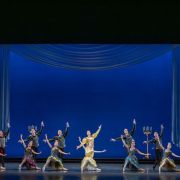
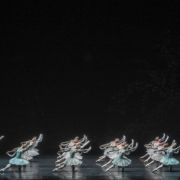
The ball scene is stronger. Rose’s costumes work well here against the bright white set. The women wear gowns of black and crimson red, each of a slightly different style and design. The corps have sharpened up here too after appearing a little scruffy in Act 1 and the scene is largely a showcase for them. It takes a while before the couple finally meet in a brief pas de deux which is predominantly floaty lifts, not allowing any kind of chemistry to develop. Prokofiev’s score swells with drama, typically we see a clock tick towards midnight but not here, the stage is cluttered with party guests and the conclusion felt disappointing. The Prince finds Cinderella’s shoe, but she is never later reunited with it in a confusing narrative point.


The couple’s final dance provides a more satisfying conclusion. Together Linnane and Larzelere are a sweet pairing, they dance with a vibrant energy. This is not an urgent love of great passion, but a careful, slow burn, with gentle partnering and bursts of joy against the backdrop of a blossoming tree (a motif that grows bigger throughout the performance).

There are moments of great sensitivity and softness in A Cinderella Story, but the journey to get there feels laboured. The storytelling is largely clear, and the principal roles are danced well, although there is often not much to work with choreographically. Additionally, at two hours and forty-five minutes with one interval, the story is bloated. Extra scenes and the extending of others last long after they have made their point; Act 1 is especially heavy, with the unnecessary comings and goings at Cinderella’s home and her relationship with her father. Perhaps most unforgivable of all is how it fails choreographically at the most critical moments. The lead up to the ball requires some magic and excitement, but of course there is no pumpkin, no glittering gown, and the glorious waltzing Prokofiev score is used to underwhelming effect. Neumeier’s retelling is more human and less fairytale, which some may enjoy but will leave others feeling flat.