Balanchine’s ballets are often thought of as ‘timeless’. You can’t put a time and a place on Serenade or Four Temperaments. But Balanchine also made ballets that were clearly of their time. Orpheus is one – it was clearly influenced by Martha Graham, down to the Isamu Noguchi decor. This season, New York City Ballet revived another piece that seems very wedded to a specific time and place.

Pithoprakta debuted in 1968, during the height of the space race. As Suzanne Farrell said in an interview with the New York Times, “The whole world was talking about going to the moon — everybody’s life was revolving about what life is going to be like outside of what we have and so perhaps that was interesting to him”. The backdrop looks … well, galactic. Iannis Xenakis’s score is more sounds than notes. The corps in the background almost look like black moonrocks, with the way they’re huddled up like balls. They are crouched and patting the ground like little space robots.


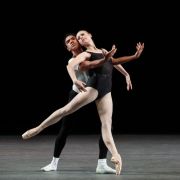
Pithoprakta was also made at the height of Balanchine’s personal obsession with Suzanne Farrell. The central role’s steps have all the Farrell mannerisms – the hip swings, high kicks, off-balance turns, loose hair, woman front and center while the man is treated as an invisible background partner. She’s an elusive and dangerous half-alien, half-siren, which is how I suspect Balanchine viewed Farrell.
Farrell actually had to reconstruct the male role from memory, so perhaps Arthur Mitchell originally had more to do than Davide Riccardo? His most memorable moment is him crawling backwards onstage. But mostly, this is a Farrell solo with occasional interjections from an anonymous partner, much like Tzigane/Errante.

You see traces of other Balanchine ballets in Pithoprakta. Nadon does a floor-touching penché followed by a bridge over Riccardo’s body, a move Balanchine recycled for Stravinsky Violin Concerto. Some of the wilder off-balance turns and lunges look borrowed from the Dulcinea Dream sequence from Don Quixote (you can see clips on Youtube). Ending the ballet on a dark stage with a lone spotlight that shrinks reminds one of Duo Concertante.
Nadon was tremendous. She is probably the closest dancer to Farrell in terms of daring, plushness of movement, and charisma. She is (as Arlene Croce said about Farrell) “always off-balance, always secure”. She made you believe in this weird little ballet, the way I’m sure Farrell made audiences believe in 1968.

But is this ballet a masterpiece that deserves regular rotation in the repertoire? Alas, no. Its brevity (9 minutes long) and strangeness made it a curiosity, which is why I suspect it hasn’t been performed since 1969. It also fetishizes Farrell too much, like she’s an extraterrestrial deity. The best roles for Farrell made her remote, yet still human (Diamonds, Chaconne, Mozartiana). Yet I am grateful I saw it. At the end of the ballet, Farrell herself took a curtain call, and it was heartwarming to hear the loud applause. Farrell had been absent from New York City Ballet for far too long, but she’s come back several times to coach and stage. Better late than never, right?


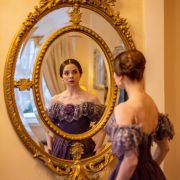
Balanchine classics filled the rest of the evening. La Sonnambula had a performance from Unity Phelan and Taylor Stanley. Phelan goes for the quieter, more contained interpretation of the Sleepwalker, without the Victorian romantic mannerisms of other interpreters. As an example, Phelan’s hair was straight and combed, whereas dancers like Sterling Hyltin or Alexa Maxwell frizz their hair to give a wilder look. It’s pretty, if a little muted. Taylor Stanley, on the other hand, leaned into the 19th century angst of this ballet. Naomi Corti sizzled in her debut as the Coquette.
The infrequently cast Ashley Laracey gave us a nice cameo with The Unanswered Question portion of Ivesiana. And finally, there was a rousing performance of Theme and Variations with Tiler Peck and Roman Mejia displaying their patented blend of showmanship and precision.