“What a dreadful idea,” was Lincoln Kirstein’s first reaction on hearing that George Balanchine was creating an evening-length ballet around Fifth Avenue jewelry. The New York City Ballet impresario worried: “The very title sounded expensive before any step was taken.” That may well have helped ensure its immediate success with the bejeweled class whom Kirstein and Balanchine needed to court after the company’s costly move uptown to Lincoln Center. Yet Jewels’ robust popularity over six decades rests not on its lingering association with fancy bling but on the way generations of dancers have mined Balanchine’s abstractions, sparking flashes of spectral color and stirring currents of emotion beneath the steps.

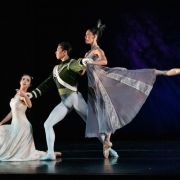
The curtain rose on the Emeralds ensemble, with the radiant Indiana Woodward at its heart in the Violette Verdy role, attended by Taylor Stanley, who handled her like Limoges. Stanley’s haunting devotion was tinged with melancholy, as if they sensed that parting was near. (Stanley retires in February.) All effort vanished: in the fleetness with which Stanley swept Woodward up from kneeling, in the billowy lifts, in the oddly beautiful passage of hands joined high above her head, framing her swaying torso as if sheltering her from rain.


Adrian Danchig-Waring, himself retiring next month, paid grave, studious attention to Emilie Gerrity in the Mimi Paul role. Gerrity contains multitudes: refined and pensive in the solo to Fauré’s wistful Sicilienne, fearless and ebullient as she gatecrashed the ensemble revels, quietly grieving in the final moments.

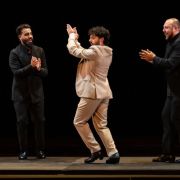
Between Emily Kikta, Tiler Peck, Roman Mejia and the dynamite corps, Rubies was smoking hot. Had the glamorous, high-kicking, pointe-stabbing Kikta fully opened the throttle, alarms might have gone off throughout the house. Her quizzical charm turned flinty as four men locked on to her wrists and ankles, arranging her limbs in extreme positions, the threat amplified by Stravinsky in spy-thriller mode. Kikta sent them slouching into the wings, then announced her own majestic departure with a series of slow plunges into steep arabesque. Here, for once, the work showed in fierce concentration as she recovered from the first wobbly penché to secure the final one in triumph. Watching a dancer rally can be more exhilarating than constant perfection.

Peck and Mejia’s bulletproof partnership amplified the risks in their jaunty, off-kilter, limb-flinging, hip-thrusting duet, treating Stravinsky’s complex rhythms like child’s play. He spun her through lightning-fast, off-axis promenades and tossed her into twisty jumps, momentarily letting go at the top. She barreled through spiky traveling turns, elbows jackknifing for speed; he shot through the air at impressive altitude. But while Kikta and Peck shared a thrill-seeking espièglerie, Mejia alternated between a vacant expression and a toothy grin, seemingly uncoached to inhabit a role beyond its technical demands.

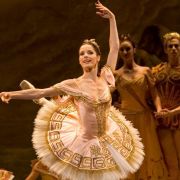
The longueurs of Diamonds’ opening movement were dispelled with the appearance of Mira Nadon and Chun Wai Chan, dancing the ballet together for the first time (though they have danced it with others). From opposite corners of the stage they negotiated an invisible maze with ritual formality. Once united, she seemed unsure whether she wanted his support. She’d dash to a corner and draw an invisible bow and arrow, facing away from him, as if this were a private pursuit or perhaps a warning of danger ahead. Then she’d bourrée back toward him to unfurl a gorgeous extension, spiral off balance and recover in the nick of time, plunge into a backbend or penché. It was touching to see her glance over her shoulder from time to time, as if checking that he was there. Suddenly, impetuously, she hugged him. Between other pairs I’ve seen, the hug remained a gesture without contact. Here it was poignant, a breach in her otherwise remote, formal manner toward him. Chan remained gravely solicitous; if fires burned, they burned deep.


In the Scherzo, both soared and spun with regal, spacious attack, spurred on perhaps by having sealed a political alliance between two nations – suggested by her triumphant brandishing of the imaginary bow and arrow as she circumnavigated the stage, and by the folk-dance elements of the ensemble choreography. Crowds amassed for the thrilling final polonaise: geometrically intricate, relentlessly perky, like most Balanchine finales yet dazzlingly its own. Among the shipshape corps, Kloe Walker stood out: luminous and stylish, a master of rubato.

Like great art, Jewels danced this well is rigorous, incandescent, yet points to another realm we can’t quite see. But its expansive dancing and air of nonchalant chic were sabotaged in every movement by claustrophobic sets in garish colors, like the forts we built as children by throwing blankets over chairs – only here the interior was hung with cheap-looking baubles. I longed for the Bolshoi’s simple backdrop of twinkling stars against an indigo sky in Diamonds, or Paris Opera’s dark void in Rubies, dominated by an enormous iridescent lozenge suspended ominously above the dancers.