

Geneva’s Bâtiment des Forces Motrices, a former hydraulic power station turned cultural venue, rises from the Rhône, reflected in its waters and soaked by November rain, as we are. Fittingly, it plays host to Océans, a water-themed double bill of works by Damien Jalet and Kyle Abraham. Under Sidi Larbi Cherkaoui’s direction, the Ballet du Grand Théâtre de Genève presents a carefully conceived evening with considerable intellectual flair. In the substantial programme booklet, dramaturg Louis Geisler lays out the aesthetic framework through essays rich in literary, artistic and philosophical references, as well as interviews with both choreographers.

There Jalet recalls how his Brise-lames, created for the Paris Opera in 2020 and now entering the Geneva Ballet’s repertoire, drew inspiration from the pandemic’s language of ‘waves’ and ‘front lines’, as well as from the breakwaters of Saint-Malo, hence its title. The scene opens with the nine dancers kneeling in a line, in cool-toned overalls designed by JR, reaching into the light one after another, resembling the black and white keys of a piano. They give body to Koki Nakano’s minimalist, pulsating score, performed live by the composer on grand piano and synthesiser.


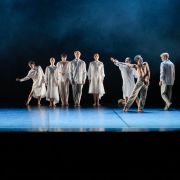
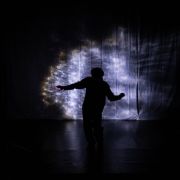
The dancers slowly rise, as though drawing strength from a liquid floor. Their undulating movements in canon are hypnotic, their arms seeming to follow the melody, their legs the rhythm. It is beautiful to watch these calm, sinuous phrases grow increasingly energetic. Tension builds and the waves turn violent, the dancers visibly straining against their force. At one point, the music fades, leaving space for the sound of their laboured breathing. A sudden crash follows, like an electrical explosion. It feels like a reset. When the music resumes, now more meditative, the dancers move in slow motion and draw closer together, forming the outline of a boat on the floor, evoking the plight of migrants at sea. One of them, Jared Brown, looks up into a camera, his face projected on the backdrop, his intense gaze meeting ours.

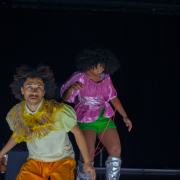
We are then catapulted into the more colourful world of Kyle Abraham’s River Without Banks, a new creation for the Geneva Ballet. Set, music, movement and costumes share a fluid quality that evokes the passage of time. Yet when we are absorbed in music, time seems to dissolve into an eternal present, into a ‘river without banks’, in the words of musicologist Henry Orlov, whose phrase inspired Leo Svirsky’s score. Indeed, we find ourselves drawn into the spellbinding interplay of the two pianos, performed live by Svirsky himself and Reinier van Houdt alongside recorded music.

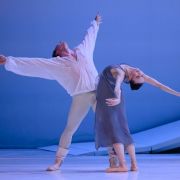
In Dan Scully’s set, a large expanse of fabric in predominantly warm tones hangs at the back of the stage, first sagging and then stretching out, its patterns echoed on the floor in patches resembling pools of water. The opening duet between Anna Cenzuales and Nahuel Vega effectively conveys the tension between desire and detachment through a dynamic play of weight and counterweight. The eight dancers return to this tension in solos, duets and ensemble passages. The choreography blends ballet, contemporary dance and hip-hop, shifting from isolations and curved lines to sudden, expansive movements accentuated by Reid & Harriet Design’s flowing costumes. Towards the end, the dancers come together in a kind of grand adagio, mostly with their backs to the audience.


And to water we return, as we step out into the pouring rain, enriched by a sophisticated and conceptually layered double bill that, beyond the powerful symbolism of water, explores our nature as social beings. Jalet emphasises collective resilience and empathy in the face of the overwhelming force of nature, while Abraham reflects on how time changes human ties, shaped by the conflicting needs for solitude and belonging. The idea that we are stronger together seems to run through both. Much praise is due to the dancers, warmly applauded by the audience, and to the entire creative team for bringing such a complex undertaking to the stage.
Elsa’s trip was sponsored by the Ballet du Grand Théâtre de Genève