The Munich Philharmonic must be familiar with the Elbphilharmonie, a venue that shares its acoustic design lineage with the orchestra's Munich home, the Isarphilharmonie. This shared sonic DNA was evident throughout the evening in performances marked by clarity and polish, though the interpretive approach favoured transparency and youthful energy over emotional weight.

Opening with Debussy's Prélude à l'après-midi d'un faune, the orchestra delivered polished woodwind playing and carefully blended colours, the long, floating lines shaped with consistent refinement. While the playing was secure, elegance remained the dominant impression; the work's underlying sensual tension felt somewhat contained, leaving the listener with a faint hunger for the unspoken.
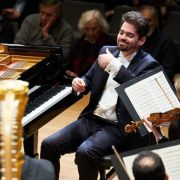
Mozart's Piano Concerto no. 27 in B flat major, K.595, immediately shifted the focus of the evening and proved the interpretive highlight. Leading the orchestra from the keyboard, Lahav Shani traced a clear dramatic arc across the three movements: an autumnal first movement touched by reflection, a second movement of inward calm and a finale combining openness with playful ease. His playing was energetic and direct, marked by a sense of spontaneity and a distinctly vocal character. Particularly impressive was his discreet use of improvisatory ornaments and transitional passages, organically and idiomatically woven into the musical flow. The Munich Philharmonic, scaled down to chamber proportions, acted as an extension of Shani's musical thinking – alert, responsive and unfailingly attuned to the improvisatory spirit of the moment. In this performance, Alfred Einstein’s famous view of Mozart’s piano concertos as fundamentally operatic found vivid confirmation.

After the interval, Schoenberg's Pelleas und Melisande was approached as symphonic drama in which Shani prioritised forward motion and textural transparency over psychological weight. Every section of the orchestra was given moments to shine, with winds, strings and brass all receiving solo opportunities. Mélisande's winding, descending lines emerged with appropriate fragility, while Golaud's more stable, angular motifs cut through the texture with clear insistence. The tower scene – where Mélisande's hair cascades in one of the score's most overtly sensual passages – bloomed with Straussian glow, the strings richly coloured yet carefully contained. The concluding funeral march unfolded with restraint, its fading textures suggesting tragic stillness. The interpretation favoured instrumental precision and architectural clarity over late-Romantic heaviness. Overall, the performance felt like tasting young, crisp white wine where one might expect a mature, complex red.
Over the course of the evening, Shani demonstrated a clear affinity for transparency, energy, and momentum, qualities that served Mozart superbly while offering different perspectives of Schoenberg. This youthful aesthetic will not suit all tastes, but like many major orchestras embracing younger, internationally-minded leadership, the Munich Philharmonic is clearly positioning itself for a period of interpretive renewal.