Andrew Yee later remembers the evening concert in Brooklyn’s Prospect Park, “sandwiched by unbreathable air from wildfires and a tornado.” Smoke from Canadian wildfires and extreme weather warnings had made for an extreme week in an otherwise tempestuous summer, but the July night was calm, cool, and reflective.

“We got that one night, which is incredible,” the cellist recalls after the performance with her Attacca Quartet. “What a blessing that we got to have that one beautiful night, and we all had trust that we would meet each other there.”
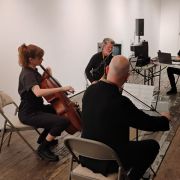
The concert, a ticketed event labelled Forever Green Soundbath, was held in the park’s Cherry Esplanade, an open meadow surrounded for the night by speakers. The program was an unusual turn for the string quartet, which has recorded works by Haydn and Ravel as well as John Adams, Philip Glass and Arvo Pärt. For this concert, they returned to employing improvisation, as they had in their early years, building a 75-minute, amorphous, uninterrupted suite around two works by frequent collaborator Caroline Shaw, using unscripted passages to connect the movements.
It was a dusk-to-dark immersion with no program and no announcements from the stage, primarily lit by fireflies and the waxing moon. Shades of Bartók and Shostakovich, shards of Philip Glass and waves of a Carter Burwell soundtrack fluttered, circled and stormed through the Cherry Esplanade.
“I think we were all just very super present,” she says. “And I think the audience was too. We are so used to the feeling of playing together, because we’ve been together now for 24 years. We just get each other’s instincts. In a way, we’ve been practising for this for a very long time.”
The concert came just three days after another major moment for Yee, the album release of her Trans Requiem, a powerful, half-hour work for orchestra, choir and vocal soloists, specifically transgender singers. It’s a profound and impassioned statement, not breaking from the rich tradition of funeral masses composed by Ockeghem, Bach, Mozart, Verdi, Britten and so many others, but updating it and infusing it with contemporary meaning.


Writing the requiem “began when Trump was elected the second time,” Yee says. “The first Trump presidency was – difficult. But what was surprising was how long the effects stayed after he was out of office. When he was elected a second time, I was just thinking about ‘how long is this going to last?’ There were a lot of people saying, ‘yo, make art, make art and protest’, and I was like, I don’t really want to. I just kind of want to be sad about this for a while.”
The desire to compose for the moment was there, but the form came to Yee while playing Massenet with the Novus orchestra and Trinity Choir, two resident ensembles of Trinity Church Wall Street in lower Manhattan.
“I was just hearing all of the different settings and thinking about requiems, and I thought, ‘Oh I could do this. I can use this feeling that I’m feeling right now,” she says. “And the way that I was feeling at the time, was, incredible grief, and I thought, ‘What a historic way to express grief’.”
Novus and the Trinity Choir performed the premiere with Yee in September 2025, on a program with works by Samuel Barber and Pauline Oliveros, and appear on the recording. The work hasn’t been performed since the premiere – a concert Yee likened to the Soundbath in feeling a connection with and from the audience – but performances are scheduled for this November in Boston.
Yee’s score incorporates the traditional mass text, poet Jennifer Espinoza’s Death Before Detransition as well as her own experiences. The emotional apex of the work is Would You Have Mercy?, a plea in the form of a fragile ballad sung by Yee and inspired by the Kyrie eleison. “Where in your heart do I live? / Where in your heart can i live / And if i promise to pretend to be a boy again, would you have mercy?” she sings over cello strums that lead to orchestral swells.
“It’s a requiem about trans people, and about trans rights, with a choir singing Lux aeterna” she says. “That is something that you can’t really recreate with any other words. There is something attached to them that is so ancient and so in our bones. I wanted to have the dignity of this historical form, and have it be for trans people.
“I wrote a piece about transness in mourning, trans deaths, and how to move forward, but I think that a lot of the things that I wrote about are very human,” she continues. “What does it mean to just be able to exist? It can speak to so many different types of people. Would You Have Mercy happens to be about walking down the street as a trans person but, could very easily be transferred to the experience of a person of color, or a woman, or a differently abled person.”

Such might be an accomplished year for some, but Yee’s 2026 calendar is marked with other events of note. Or, the Whale, a duo album with the composer, singer and longtime friend Caroline Shaw was released in May. In February, Attacca released a recording of David Lang’s powerful chamber opera Note to a Friend. And this winter, Yee is touring with the Rothko String Quartet, marking the debut recording by composer inti figgis-vizueta.
Despite sharing space with Moby Dick, the heart of Or, the Whale comes at its midpoint, with Messiaen’s Louange à l’Eternité de Jésus (from Quatuor pour la fin du Temps), following Messiaen’s arrangement for violin and Ondes Martenot but transcribed for cello and Shaw singing through a harmonizer.
“That was a sort of callback to a time in the pandemic,” Yee says. “I was having a really hard time and the thing that got me through was I made an arrangement of the Louange for five cellos, and I recorded it by myself. It was a very emotional experience, and so I thought it would be a good idea to try that with Caroline”.


Note to a Friend is a heavy monodrama inspired by the suicide note left by author Ryunosuke Akutagawa, recorded by Attacca with baritone Theo Bleckmann. It is by no means an easy set of songs.
“A lot of us have people in our lives who we’ve lost to suicide,” Yee says. “We’ve had talkbacks after the shows and there's a mix of ‘Oh, thank you, thank you for that, I needed that’ or ‘That was awful. I can’t believe I had to sit through that.’ It is a super intense feeling to perform it.”
More recently, Attacca has recorded Lang’s Daisy, a piece recalling America’s involvement in the Vietnam War, for a forthcoming album, giving its North American premiere at the Park Avenue Armory last year. Intensity and raw emotion are not unfamiliar in Yee’s work.
Such emotions are strongly present in figgis-vizueta’s debut portrait album, Music for Transitions, releasing 6th November on New Amsterdam Records. The collection of five works was composed in close collaboration with Yee over six years, which the composer describes as “snapshots of my own journey and heritage and history. I was in a very Cagean moment,” she says, referencing John Cage’s Music for Changes. Also working with the Rothko String Quartet at the time, figgis-vizueta was thinking about Schubert’s String Quintet, and the pieces started falling together.
Cultural generations can go by quickly – figgis-vizueta says she sees Yee, nine years her senior, as a forebear. “We kind of were undergoing gender journeys simultaneously”, she explains.
“Her playing and navigating of all this stuff has felt like one generation ahead of me while I’ve been lucky enough to be colleagues with her. She’s an incredibly generous collaborator and one who will tell you when she likes something and when she doesn’t like something. I really appreciate that.
“Andrew has this really amazing quality of gathering people and when she gathers you, she feels like someone I can approach with ideas. To me, that’s almost like grandma vibe.”
But for her part, Yee finds guidance in someone younger still. Born in Ohio in 1984 and trained at The Juilliard School, Yee now lives in Brooklyn with her wife and 4-year-old son, who she says serves as “a guide for what's important and what is real. He doesn’t care about what Trump says, you know? He doesn’t care. He just knows that, he trusts me, and he loves me, and that I love him.”
Their son manages to be an inspiration even when he’s not home. Yee uses the bedroom for composing and wrote the entire requiem there while her son was at school.
“I think that’s maybe the most beautiful part about being an artist,” she says. “You can take these things, you can put it in your art, then you can slap a title on it, record it, and then throw it out. I think that's really wonderful that I got to do that. I’m so happy that it was there, next to his gigantic flamingo.”
Andrew Yee’s Trans Requiem is performed on 22nd November at the Church of the Covenant, Boston, Massachusetts.
See upcoming performances by Andrew Yee and the Attacca Quartet.