“In El Sistema, we have this saying: play, sing and fight.” I’m speaking with young Venezuelan violinist and multi-instrumentalist Pablo Agudo López. He’s been in the midst of rehearsals, but looks resolute. To say that 2026 has been an eventful year for Venezuela would be a gross understatement. “This year has been one of the most complicated for the country, with all the things that have happened. And then the earthquakes – almost the worst thing to add to this year.”

In June, two earthquakes hit areas near to San Felipe and the capital Caracas, leaving around seven thousand dead, and thousands more injured and missing. It was the strongest earthquake to hit Venezuela in more than 100 years. “It’s terrible. But at the same time, I have so much admiration for the people. They’re always fighting, they never stop.”
As a graduate of famed Venezuelan music education programme El Sistema, despite moving away to Geneva to continue studies in Early music, Agudo has maintained close links with musicians back home, frequently working with the Simon Bolivar Baroque Orchestra, part of El Sistema. “Play, sing and fight. We have proved it with this earthquake. Their priority was to help everybody, not only the families from El Sistema, but everybody. The buildings were opened up, welcoming people in to help.” Much of Agudo’s family remains close to the capital. “It’s a terrifying situation. There were friends of mine that died. But I will never stop believing in my country.”
Agudo is part of a crucial younger generation of musicians seeing connections between European music and its parallels elsewhere. The traditional and folk music of Latin America retains many characteristics which may well be closer to Early European music than modern performance practice. It’s something Agudo will showcase in two programmes in Geneva at La Cité Bleue, bringing together European and Latin American music and instrumentalists.


“My father is musician who played a lot of folk music, and he also played the double bass in a classical orchestra. But he’s mainly a folk musician. I always grew up with this: listening to violin concertos or symphonies of Beethoven or Brahms or Mahler, then completely switching to Venezuelan music or Cuban music. Jazz too!” Recordings of Baroque music by Harnoncourt, Pinnock and Kuijken were also readily available. “But Baroque music is alive in our country… When I play traditional Venezuelan music, I feel that I’m playing Baroque music really. Venezuelan music was born in this period, with African music, music of indigenous people, mixed with the Spanish and Italian as well.”

It is a mix Agudo is grappling with directly. At the moment, he’s preparing a new interpretation of Italian composer Antonio Cesti’s gargantuan opera, Il pomo d’oro (The Golden Apple). Originally composed for the wedding of Holy Roman Emperor Leopold I, in its first staging in 1668 the piece lasted upwards of 7 hours, spread over two days. It required a bespoke theatre and an enormous cast for its 48 sung roles. But rather than performing the whole piece (something only done this year in Innsbruck, the first time since the premiere), Agudo is focusing on the two acts for which Cesti’s music is lost. Fortunately, the libretto survives.
“I’m using a lot of elements from Cesti’s music – not only from this opera, but from other operas as well. But at the same time, it’s a contemporary recreation. The base is Italian 17th-century music, but I also take influences from Latin American music that for me is so connected to the Baroque. For me it’s not separate.” Seeing connections between popular and traditional musics was hardly out of character for composers of Cesti’s time either. “Those composers, they weren’t thinking with categories that we use today,” Agudo says. “The tools they used to compose were all the music they listened to! Music from the church, music from the theatre, music for the king, music of the people. They’d mix it all together.”

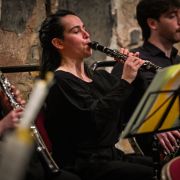
It’s a musical multipolarity on display in another Geneva programme coming up in November. Agudo is performing together with his ensemble Les Impertinences, a mix of young period-instrument performers from across Central and South America. Baroque music is taken together with popular and folk music of the time, as well as some popular music of today. “It’s a programme that our cello player Emma Vignier imagined. When we work, we are playing Baroque music or Early music. But when you get out of the rehearsal, you are going to listen to, I don’t know, Beyonce, or the Beatles… All the music that we hear, it’s all in our heads – it makes our beings.”
As well as being a violinist, Agudo is a multi-instrumentalist – for this programme, he will take up the cuatro, a four-string relative of the guitar common to Venezuela, Cuba and Puerto Rico. It derives from Spanish instruments of the 15th century. “It’s an instrument that was born in the Baroque period and still exists today. It’s the instrument my father played me all the time from when I was a child.”
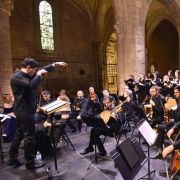
A willingness to adopt influences from folk and traditional musics also owes something to the mentorship of Leonardo García-Alarcón, the Argentinian harpsichordist and conductor of Cappella Mediterranea, resident ensemble at La Cité Bleue. “He’s very connected with this approach. This philosophy that Baroque music is alive in Latin America. He has a lot of this in his performance, and is talking about this all the time… With my ensemble Les Impertinences, we want to go as far as possible with this philosophy. To go even further, with all the sources that we can get hold of.”


Taking influence from popular, folk and traditional musics has long been a part of the Early music movement. But among younger period-instrument performers today, it seems a trend gaining in popularity – from Scandinavia to the Balkans, Greece, Spain and Latin America. I ask if he thinks one reason for this trend is the large body of recordings made over the last several decades. With so much music played and recorded already, are younger performers being drawn elsewhere for music to perform?
“I asked almost the same question to a violinist I played was playing with for the last two months, Lisa Tur Bonet,” Agudo says. “I asked her how she felt about the future of Early music for younger generations. Both of us had this feeling – like a lot of people – that everything has been ‘said’ already. When the Early music movement started, it was amazing because people didn’t have any prior references. Today we have a lot of references. We have everything we could have! Sources, recordings, the treatises my teacher told me I had to read.” The sheer weight of pre-existing material does have its consequences for younger musicians, he says.
“We are afraid of taking risks. And we shouldn’t be afraid, because the people who started this movement. They weren't afraid – I mean, maybe they were, they did it anyway.” Taking influence from traditional music leads to new approaches to performance practice too. The characteristic sound of modern period-instrument performance – crisp rhythms, clear articulation, ensembles sharply in time, together and well in tune – has little basis in historical sources. It has more to do with the demands and tastes of the modern recording industry.
But folk and traditional musicianship offers a broader palette of possibilities. Looser articulation, a more flexible approach to tuning and rhythm, wider changes in tempo and dynamics. Agudo tells me that he sees echoes of this performance practice in the surviving treatises. For instance, Baroque violinist and writer Georg Pisandel informs players to put their bows a finger’s width from the bridge. To do as much causes a harsh timbre, and on gut strings the effect can be wild, even “violent”, he says. “I say violent because today we think like that. We think it’s ugly – but it’s just a colour.”
This willingness to find alternative approaches to performance, which may be close to historical practices, is at the heart of Agudo’s thinking. “It’s also why we – our ensemble – are called Les Impertinences. The impertinence! We had a masterclass with a teacher who told us our playing was ‘uncivilised’. That Emma, our cello player, because she’s French, had to teach us to be more composé. And we thought, ‘enough of this!’ That we have to go to the end with this approach. That we couldn’t be in the middle. This ‘uncivilised’ thing – we have to take it in our favour.”
At the same time Agudo is very much aware of his place within a lineage. “Whatever I’m going to do, I will continue the legacy that Leonardo has been teaching me. The legacy from my father, the legacy from El Sistema. All of the people that trained me, that made me.” Music makes us in ways we’re not even aware of – fortunately this is something young performers are ready and willing to embrace.
Pablo Agudo López performs with Les Impertinences at La Cité Bleue on 5th November. The venue’s season closes with Agudo’s interpretation of Il pomo d’oro on 26th & 27th June.
See upcoming events at La Cité Bleue, Geneva.
This article was sponsored by La Cité Bleue.