In this article series, together with Sustainable EEEMERGING and its partners, we explore Early music across Europe – and the challenges faced by young artists in various countries across the continent. What is the condition of Early music today?
This article was supported by GhislieriMusica.
Is it easier to for musicians to find a shared sensibility today than in previous centuries? In 1707, Alessandro Scarlatti arrived in Venice to present a new opera Il Mitridate Eupatore, with a libretto written by a local Venetian Count. The result was a fiasco, one of the worst of Scarlatti’s career, and he would receive no further commission from the Venetians. What went wrong?

“They just couldn’t play it because it was so alien – it was a catastrophe,” conductor Giulio Prandi tells me. “It was very personal, Scarlatti’s style.” With operas typically mounted in Venice in only a handful of days, the musicians struggled immediately. “And without a sense of shared language, this can happen to us, today.”
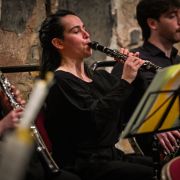
Prandi founded the Coro e Orchestra Ghislieri in the North Italian city of Pavia in 2003 – they are now one of Italy’s leading Baroque music ensembles. Prandi conducted Mitridate at Teatro Massimo di Palermo last autumn, and the music of Alessandro Scarlatti has been of particular importance to the orchestra, who celebrated the third centenary of Scarlatti’s death in 2025 with several sacred choral works.
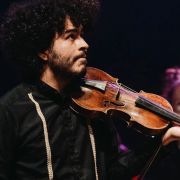
When we speak, Prandi is sat in his apartment alongside concertmaster Gabriele Pro, ahead of a performance later in the evening – of unusual works by Handel and his Italian contemporaries Giovanni Bononcini and Antonio Caldara. All three made their careers crossing linguistic boundaries: Caldara, born in Venice, ended up as Kapellmeister to the Imperial Court in Vienna. Bononcini, meanwhile, became one of Handel’s chief rivals in London in the 1720s. (Bononcini was favoured by the Whigs; the Tories preferred Handel.)


Today, the situation is not so different. Italians are cropping up everywhere. “There are fantastic Italian musicians in ensembles based in Amsterdam, in Paris, in Lyon,” Prandi says. “Maybe you cannot even say a French ensemble is a ‘French’ ensemble. They might be based in Lyon because they all studied in Lyon – but it’s two Italians, one Spanish, two Polish, and one Brazilian and two French, you see… Ensembles are born around schools, not around nationalities.”
Gabriele Pro is also acutely aware of the need for shared sensibilities. He has recently been appointed Music Director of the Junges Musikpodium, a youth orchestra which pairs young musicians from Dresden with peers from Venice and the Veneto region. (After projects in Italy this year, they will shortly perform at the Dresdner Musikfestspiele.)
The Musikpodium recapitulates a relationship which itself dates back the 18th century, when the Dresden Court Orchestra was famous across Europe. “Vivaldi wrote music for this orchestra – with this project we want to recreate this special atmosphere, between Venice and Dresden.” The concertmaster of the Dresden Court Orchestra, Johann Georg Pisendel, one of the leading violinists of his era, studied with Vivaldi and Giuseppe Torelli. A later Dresden Kapellmeister, the talented Johann Adolph Hasse, was even more of a cultural hybrid: born near Hamburg, training in Naples, popular in Venice and Vienna, and working for years in Dresden, Hasse perfectly exemplifies the cosmopolitanism of 18th century music.

Music-making then has always been the province of mongrels and transplants. But musicians shouldn’t be forced into wandering the continent for the sake of their careers – surely they should be able to make a stable go of it in their home countries too? “Not because I don't like to play abroad, or live abroad,” Pro says. “But I like to play with Giulio, and to have projects in Italy. For me it was important to play and to live in Italy, to share my culture and music with society here.”
“But it’s difficult to live as a freelance, historically-informed musician in Italy,” Pro adds. “Because there aren’t so many ensembles now in Italy. There are the established ensembles like Il Giardino Armonico, Accademia Bizantina, Europa Galante.” These influential ensembles were founded in the 1980s and 90s. But Ghislieri is one of the only Baroque orchestras founded in the 2000s.
“Is it normal that Ghislieri is the only Italian established ensemble of its generation?” Prandi asks. In terms of prestige, the orchestra, he argues, is now in the position that Giardino Armonico was when Ghislieri was founded. “We play in the Concertgebouw, in La Scala, the Berlin Philharmonie. But who’s next?”
Gabriele Pro did found his own small ensemble, Anima & Corpo, ten years ago – and it has since gone on to record several well-received albums, including a recent release of Roman Baroque rarities with soprano Carlotta Colombo. But it is an occasional endeavour: the frequency of their performances pales in comparison to ensembles of previous generations. Meanwhile there is no regularly performing Baroque orchestra founded in Italy in the 2010s. (Orchestra il Pomo d’Oro, founded in 2012, is perhaps closest, with many Italian musicians, but the ensemble is based in Switzerland.)
The paradoxical nature of this situation is apparent especially to Prandi, who is in demand as a conductor away from Orchestra Ghislieri. He is finding that Italian opera houses are more open and curious about historically-informed performance than ever. Sensibilities are opening up, even at traditional institutions. Conducting Dido and Aeneas at the Arena di Verona, Prandi has since conducted at La Scala, Palermo, the Maggio Musicale, San Carlo and elsewhere. Italian orchestras are not nearly as conservative as one might assume: “when you tell them interesting things, they are quick to respond – and they remember that there are many things to discover,” he says.
Early music teaching in Italy has also improved markedly in the last 25 years. “When you wanted to study Early music, you had to go to the Netherlands, to Switzerland and so on,” Pro says. “Now I think the ecosystem in conservatoires is much more open. The teachers also: the sensibility of musicians has changed.”


“In Pavia, the Conservatoire is very eager for GhislieriMusica to teach them to play 18th-century music: Haydn, Mozart and even Schubert,” Prandi adds. “Yesterday they played the Fifth Symphony by Schubert – with modern instruments, of course, but the concertmaster was one of our colleagues from our ensemble. They played with modern instruments but with a sensibility for historic performance.”
Prandi expands: “There’s something important – that for younger generations is certainly natural, as many of them were born into this knowledge, while my generation and the generations before mine had to dig for it – which is that historically informed means that you have to be informed. But what has to drive you is your musical spirit, your sensibility. The problem is that you have to trust your sensibility. And in order to trust your sensibility, you have to nourish it. How? With study – but it’s not a direct link from a historical treatise to the stage.”
“It is the information, the context, the history, the biographies, the things you know about the music that has to nourish your spirit. But then when you are there, in performance, you have to have a connection of souls.”
It takes courage to be able to trust your own sensibilities in this way, and a willingness to get out of one’s comfort zone. I ask Pro and Prandi whether they’ve seen Early musicians in Italy take inspiration from traditional and folk musics – something noticeable in other parts of Europe, including the Balkans and Greece, and Scandinavia. “I’m trying to,” Pro says. “Because it’s very interesting to make these connections. In Italy there are so many musicians devoted to popular music – in the south of Italy, there are great musicians and researchers.”
“I think we should learn from folk musicians,” Prandi says, “because everything you read about sprezzatura – which is the way you are supposed to play without caring so much, without giving over too much importance – we don’t have that from time to time. We’re very serious, you know!”
By way of example, Prandi cites recordings by Antonio Florio and I Turchini from the 1990s: “They explored a lot of the links between traditional Neapolitan music and sacred music of the time. It’s very strong.” But Prandi is also somewhat cautious, feeling that crossover tendencies can sometimes become too much like a marketing tactic.
In any case, Prandi suggests, “innovation, real innovation, comes from independent ensembles. And independent ensembles are in a very big crisis now because, well, we need money and cost of living is exploding, travel costs are exploding. What I can say is that in Italy, you have no big Baroque festival in Venice, you have no big Baroque festival in Rome, or in Naples…”
Yet, with orchestras and opera houses becoming increasingly open-minded, and music education improving with each passing year, one suspects the Italian music scene is ripe for a significant festival dedicated to Early music, of the kind Prandi envisions. There is certainly the musical talent ready and waiting, especially among the younger generation. “We just need to give them the room to express themselves,” Prandi says. “I don’t know what the answer is – but we need to find it, because they’re good!”
See upcoming performances of Early music in Italy.
Sustainable EEEMERGING is funded by the European Union.
Views and opinions expressed are however those of the author(s) only and do not necessarily reflect those of the European Union. Neither the European Union nor the granting authority can be held responsible for them.
This article was sponsored by Centre culturel de rencontre d’Ambronay.