“Articulation is the one thing I can’t compromise,” says Sunwook Kim, with the calm of someone stating a first principle rather than a preference. “If we agree the articulation, tempo can be different. But if we don’t agree how the phrase breathes – what is truly short, what really belongs under a slur – no tempo will fix it.” When we meet in Seoul, he keeps returning to the topic of breath. “The most natural instrument is the voice. Music has to breathe like a singer: you take air, you release it. Once an orchestra and a soloist share that sense of breath, everything becomes freer and more consistent.”

That method will be tested in Paris this February, when Kim plays Beethoven’s Piano Concerto no. 1 in C major with Insula orchestra and Laurence Equilbey at La Seine Musicale. He relishes the opportunity to align his Beethoven with Insula’s period‑instrument palette – without turning “authenticity” into dogma. “When the sound‑world is distinctive I’m happy to absorb a conductor’s priorities and then adjust. The essence is the same; the colour changes with the people, the hall, the night.”
Kim rejects the old hierarchy that shelves Beethoven’s First Piano Concerto behind its later siblings. “I don’t think No. 1 has any less power or artistry than Nos 3, 4 or 5,” he says. “When I was younger I heard it as a mechanical C‑major showpiece full of scales. Now I hear what the mechanics are doing – the wit, the subito turns, the long‑breathed lines – and I can feel them, not just know them.”
It’s a shift that tracks a broader change in how he spends his musical life. “In my 20s I played almost everything. In my 30s – partly because I’ve started conducting – I play the composers I feel genuinely close to. Ten or twenty years from now I’ll approach the piece differently again. Now is not a final statement.”
Ask Kim how the First should be understood and he begins with harmony rather than motif or rhetoric. “To understand Beethoven, you start with harmony. Rhythm, narrative, humour – they all sit on the harmonic substance. Without that, the drama has no weight.” Development is where harmonic pressure is engineered; recapitulation is not formality but release. Seen in that way, the concerto’s brightness and quick tempi can mislead listeners into hearing Mozart where the fundamentals are already Beethovenian. “People hear the speed and the lightness and think ‘Mozart’. But the fundamentals are different. Beethoven is already tightening the listener’s nerves through harmony before the release.”


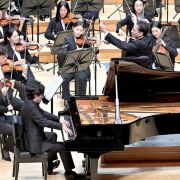
Insula’s period-instrument sonority – clean attack, quick decay, a taut wind palette – invites a speech‑like clarity. Vagueness is banished. Kim welcomes the discipline, and has a long-standing relationship with the orchestra, performing with them since 2020. Performing with Insula also means playing on an older piano, something Kim does only rarely. “It’s wonderful to meet a great instrument, but not every venue has one. My job is to find the essentials of the piece and re‑colour them for the room.”
On a fortepiano, or an instrument of Beethoven’s time, sound falls away rapidly in the upper register, and the lower register is bright and sharp, quite different from the muddier low sounds of modern instruments. With sound decaying rapidly, Kim looks for timing and touch that imply length rather than simulating it with pedal.
Even the sustain pedal itself produces different responses in earlier instruments. “I don’t ‘know’ how I use the pedal,” he adds, amused by the idea of codifying it. “I adjust by ear – to the hall, to the articulation, to the harmonic change. In a dry room I might warm the second half; in a generous acoustic I pare back. Either way, the arbiter is whether the harmony speaks clearly.”
For these performances with Insula orchestra, Kim will use an 1901 Pleyel piano, the French manufacturer preferred by Chopin. While a more modern instrument than anything Beethoven would have encountered, instruments of this period are still temperamental and respond with individuality. And as evidenced by historical recordings, pianists’ expectations of key action, and habits of articulation and phrasing, have changed considerably over that time.

Rehearsals with Equilbey often start by exploring these concerns. “Agree the articulation first – what is genuinely staccato, what is a lifted portato, where a slur implies one continuous exhalation,” Kim says. “Once that’s shared, tempo can live and flex without breaking the line.” He is frank about how much the ensemble’s shared “breath” determines the ease of that pact. “If the orchestra shares the same sense of breathing, everything is simpler; if not, it’s harder.” Set the consonants and vowels, and the sentence will look after itself.
Equilbey concurs. “Sunwook has a remarkable command of Beethoven’s style,” she says, via email. “A sharp sense of rhetoric and pulse, paired with a remarkable suppleness in his playing that brings out the full richness of rhythmic tension.” She thinks his playing blends well with Insula orchestra’s colours.
Does work with period instruments change how he approaches solo recitals? The traffic is two‑way. Discoveries made on earlier pianos, or Beethoven’s fortepiano, can migrate to the modern piano. How little resonant duration a phrase might need to speak, or the way a sustained line might be held up without a heavy modern sustain pedal – all of it keeps Beethoven from sounding too apologetic. It is less ideology than method: let the harmony lead; agree the breath; colour to suit the room.

Behind that method sits a realistic allocation of time. “I still practise three to four hours a day – honestly, every day – and the rest is score,” he says. Highly technical new terrain that demands seven or eight daily hours simply to keep in the hands is now chosen carefully and seasonally. But the list he reels off is long enough to puncture any myth of narrowing – Dvořák’s concerto; Britten; Prokofiev’s Second and Third; Rachmaninov’s Second and Third and the Rhapsody on a Theme of Paganini; Bartók’s Second and Third – and there is a near‑term return to Bartók’s Sonata for Two Pianos and Percussion. “Don’t get lazy, don’t give up, don’t lose curiosity,” he says.


All of which returns us to Beethoven’s First Concerto, and to Kim’s straightforward account of what the piece does. He hears the first movement as a single sentence artfully stretched: a witty over‑abundance that still obeys the dictates of harmony. He admires the development section’s capacity for sudden darkness – “two bars can take you into a hole and out again” – and he wants the finale’s play to be swift and purposeful, the jokes confirming the structure rather than distracting from it. None of this is new in theory: it feels fresh because it sits inside a coherent practice. “If the first bar lands naturally,” he suggests, “the rest will argue for itself.” If the orchestra’s consonants are right, the piano’s vowels can ring.
Kim’s view of cadenzas is likewise architectural. Beethoven left three options; he has played them all. “If the programme is fairly light, I take the longest cadenza. If the first half is already weighty, I choose the shortest. It’s not about where my fingers can go – it’s about timing: how long a parenthesis the structure will bear that night without losing its line.” In the Insula context – leaner tuttis, quicker attacks – the calibration matters doubly. A long cadenza after taut orchestral paragraphs can feel like a detour; a compact one can sharpen the return. The aim is to come back to the tutti with the argument clarified, not merely paused.

Insula’s disciplined sound should suit him. Kim does not pretend to be a specialist in historically informed performance, yet he has no difficulty naming what it teaches. Shorter resonance tests how you time a cadence; crisper attacks expose lazy articulation; a sparer pedal brightens inner voices. These are not limitations to be excused – they are conditions to be used. In practice that means walking into rehearsal with clear priorities and an open ear, matching the orchestra’s parts to keep the mechanics clean. Agreeing articulation before speed, choosing among Beethoven’s own cadenzas for proportion rather than bravura, pedalling by ear. Altering touch to suit the room – while knowing that audiences, more than critics or colleagues, are the final court for persuasion.
There is, in the end, something bracingly old‑fashioned about the way Kim frames the task. The score is not a relic but a system of intelligible choices; the performer is answerable for making those choices legible in time and air. Instruments can inspire, acoustics can nudge. Yet responsibility remains with the musician in front of you, and in Paris that musician intends to let Beethoven speak in his own accent – clear, witty, held together by harmony. It can be heard, as Kim believes it has always been, as Beethoven already, unmistakably, himself.
Sunwook Kim performs Beethoven’s First Piano Concerto with Insula orchestra on 18th–19th February at La Seine Musicale.
See upcoming performances by Insula orchestra.
This article was sponsored by Insula orchestra / Accentus.