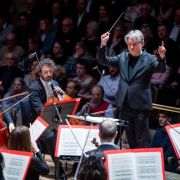
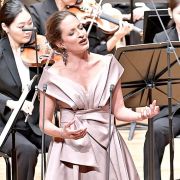
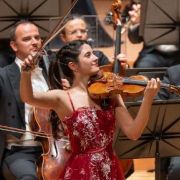
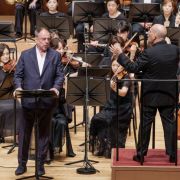
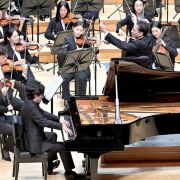
At Seoul Arts Center, a routine KBS subscription programme arrived under a revised banner: Myung-whun Chung’s first concert as the orchestra’s tenth Music Director. The repertoire stayed put, but the framing changed the listening.

Leonidas Kavakos’reading of Tchaikovsky’s Violin Concerto was built on exposure rather than varnish. The image was a skeleton clock: the dial removed, the gearing visible. Tone stayed lean, vibrato tightly rationed and the basic tempo held back so rhythmic joints and harmonic pivots could be heard as load-bearing. Virtuosity became legibility; even “connective” passagework – chromatic curls, triplet loops – was articulated with the same care as headline melody. The scene was wondrous. Yet his rubato was closer to stopping to catch breath than to breathing, and the tension that should have accumulated toward climaxes volatilised inside an analytic tempo. The cadenza, finished to the millimetre, dazzled as craft while keeping the drama slightly at a distance.


In the Canzonetta, Kavakos’ restraint deepened into something unmistakably masterly. The melody was carried on a sound so small it felt sustained on borrowed breath, like a singer past his prime pushing out a hoarse last song, forcing the line forward even as it threatens to break. It was less Tchaikovsky’s warmth than the recollection of it, and listeners who came for perfume might have found the landscape almost severely dry, even solemn. Yet the severity held, because the retreat of sound was controlled to the last degree: fades calibrated, colour pared back without turning blank, and woodwinds replying from a chamber-like distance that made the loneliness feel designed rather than accidental.
The Finale was the most contentious page. Against Allegro vivacissimo, Kavakos set a looser basic tempo and moved with the precision of a winch hauling weight: each turn measured, each notch engaged. Even passages most soloists let blur under speed were articulated note by note, a different order of technique. But the “release” after the slow movement never properly returned, and although the last stretch did quicken, the relative lift remained modest; one could feel restlessness ripple through the seats as the long paragraph asked patience more than it generated exhilaration.

If Kavakos dismantled sound, Chung in Beethoven worked to inflate and fill it. His Eroica declined clipped, angular period-school attacks in favour of roomy tempi and saturated overtone bloom – rounded beginnings, long resonance, blended choirs. The two opening E-flat chords set the movement’s scale at once, and Chung carried that tension through the span until, at the end of the development, just before the recapitulation, he drew the orchestra down to a true pianissimo: quiet with pulse, the sound retreating to the edge of audibility before the recapitulation snapped back; later, deep in the long coda, he again let the texture subside to a charged hush.


In the fugato writing, Chung resisted spotlighting each strand, shaping instead one accumulating swell; tragedy pressed, not bitten. The Marcia funebre made his case most persuasively: low strings laid the weight, woodwinds spoke with plain humanity, and the closing fragmentation was framed by rests held long enough that silence became structural rhetoric.
Execution, however, did not always meet the design. Beethoven depends on collective diction, and the KBS sometimes lost unanimity in the violins; in thick counterpoint inner parts could blur and the ensemble’s glue loosen. The Scherzo stayed careful. In the Finale, Chung treated the Prometheus theme as one long breath – variations bound into continuity – and drove the end forward with intent even as density tested internal alignment.
What remained was a partnership still embryonic: Chung’s horizon of depth, bloom and organic unity already clear, sometimes ahead of the orchestra’s present synchronisation.