Florida, home to Inter Miami and Lionel Messi, Cape Canaveral, the world’s biggest cluster of theme parks, the largest Dalí collection outside Europe, and the only living coral barrier reef in the continental United States, also happens to be home to a company of 40-odd dancers who keep the torch of mid-century British ballet style burning. That style, shaped notably by Frederick Ashton and marked by sparkling musicality, flickering footwork and gracefully rounded arms, has been nurtured at Sarasota Ballet for nearly 20 years by Iain Webb and Margaret Barbieri, both of Royal Ballet lineage. The company’s latest program, now at New York’s Joyce Theater, honors Sir Frederick Ashton in a suite of miniatures, Sir Peter Wright in his illumination of Mendelssohn’s Piano Concerto No. 2 and Antony Tudor in his 1936 psychological drama Lilac Garden.

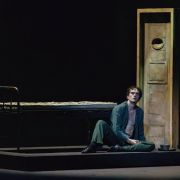
Lilac Garden is the oldest work on the program yet looks the most modern in its spare, restrained vocabulary. It may also be the hardest, demanding steely precision and delicate emotional gestures to tell the story of an about-to-be-unhappily-married woman in socially repressed Edwardian times. While garden-party guests flitted about in the lilac-scented dusk, two pairs of lovers exchanged meaningful glances and precipitous lifts – with a final beat that teased a Season Two. On opening night, Marijana Dominis and Brooke Wilson, as Caroline and her fiancé’s former mistress, were hard to tell apart: two similarly unhappy women. The ensemble as a whole hesitated now and then, as if still finding their marks.


The Ashton showcase was polished and exhilarating. A string of short works is a fair window into his range, but in a New York starved for Ashton, I wished for a single more substantial piece. Opening night was also down a divertissement from The Sleeping Beauty because of dancer illness. Still, the bite-sized offerings rewarded, none more than the balcony pas de deux from Romeo & Juliet, a scene that, whoever the choreographer, can seem overwrought when ripped out of the full-length ballet. Yet Ashton portrayed adolescent longing with a touching artlessness and built the intensity so carefully that it felt fresh and convincing. Sierra Abelardo turned simple rises onto pointe into frissons of anticipation, and Samuel Gest’s ardor seemed to sustain him in the air in cabrioles.
The high-spirited Andrea Marcelletti, Pasha Levy and Gus Payne tore through the jaunty footwork of the excerpt from Les Rendezvous.

Kaitlyn Casey and Ricardo Rhodes gave the Meditation from Thaïs an appealingly remote, otherworldly performance that underplayed the erotic, exotic allure of the velvet, the sparkles, the veil and the vaguely ‘Eastern’ devotional gestures. Casey’s shimmering bourrées, her bodyboarding on Rhodes’ back and her final dash into the wings telegraphed that she, not her smitten partner, was in charge.
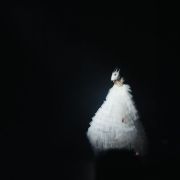
The pas de cinq from Illuminations, Ashton’s 1950 ballet for New York City Ballet to Britten’s settings of Rimbaud’s hallucinatory poems, is an eccentric beauty. Iku Okura, as Sacred Love, a role originated by Tanaquil Le Clercq, was serene in a jagged-edged tutu, Elizabethan ruff and crown with spikes like Gothic spires, from Cecil Beaton’s whimsical designs. She was wafted through the air by four bare-chested attendants who between them owned six silver lamé disco-trouser legs. Their silvery-white skullcaps, like a pope’s zucchetto, hinted at a spiritual side to Rimbaud’s feverish imagery while floppy tulle neckpieces completed the Jetsons-in-Narnia look. The men lifted Okura vertically as she fluttered her legs and waved her arms as if underwater in an Esther Williams aqua-musical. Elsewhere they flew her overhead, grasped her ankles in a split and repeatedly switched her legs mid-flight – anticipating the manipulation of the Tall Girl in Balanchine’s Rubies 17 years later. The effect was cool and unearthly.


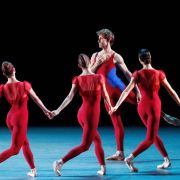
Wright’s Summertide was a triumph, unshowy but virtuosic, a showcase of elegant classical technique adapted to Mendelssohn’s flickering moods. The abstract backdrop glowed under a brilliant lighting scheme that variously suggested a deepening sky, an eroding cliffside or a deep-sea escarpment. The dancers shimmered as well, the men in beautifully mottled unitards, the women in wispy skirts to match. Pasha Levy and Iku Okura nailed the ebullient choreography of the first movement while a quartet of men soared. The men’s exuberance sometimes outran their landings, a few touchdowns bobbled, but their partnering was rock-solid, with hands placed so confidently and easily that all appearance of effort vanished.

Ricardo Rhodes was a poetic central figure who swept restlessly through all three movements. In the tender, elegiac second movement, golden light washed over all, and the exquisite Marijana Dominis bourréed with the world at peace in her eyes before sailing through the air in an enchanting panoply of lifts. Twelve dancers romped through the third movement, at the end of which Rhodes unleashed a buoyant double tour en l’air and Dominis was hoisted high in a blithe, bighearted finale.