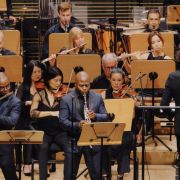
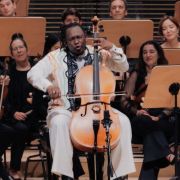
The Philadelphia Orchestra was supposed to have premiered Wynton Marsalis’ Symphony no. 5, “Liberty” on a series of concerts that included an appearance on Carnegie Hall’s ‘United in Sound: America at 250’ festival, but ten days before the concert a brief press release advised that the premiere had been postponed, and that the program would instead included selections from Marsalis’ Symphony no. 4, “Jungle Symphony”.

Luckily, The Jungle is a pretty good save for an ‘America at 250’ festival; it’s a portrait of New York City, which has an outsize role in America’s lore. It’s a large-scale piece, clocking in at about an hour. Constructed as a concerto grosso for jazz big band and orchestra, it features the Jazz at Lincoln Center Orchestra, of which Marsalis is Music Director. I had assumed that the choice to do selections from the piece – three of the six movements – were because of time constraints, but then the concert also included three compositions or arrangements by members of the band, coming before the full orchestra entered in a sort of reverse encore and adding nearly all the time back. Speculation, while irresistible, is pointless.


The work is thoroughly engaging. Marsalis integrates the big band and orchestra sounds seamlessly, except where deliberately contrasting them. Rhythmic propulsion and syncopation feature prominently. The two outer movements of the selections (Movement I: The Big Scream (Black Elk Speaks) and Movement VI: Struggle in the Digital Market) are similar, evoking the hurried but not hasty perpetual motion of New York life, with a kaleidoscopic palette of color and rhythm and a few surprises to be taken in stride; favorites included a single shouted “Hallelujah!”, a call-and-response section between the JLCO and the violins, and a passage where the orchestral percussion magnified what the drum kit was doing, as though the drummer were wearing seven-league boots. Movement V: Us, acting here as the sole inner movement, evoked the ‘society orchestra’, using the orchestral and jazz forces together to project elegance in a way familiar to fans of 1940s movies, and then twisting and commenting on the well-known tropes.
There was sporadic, proficient soloing from certain of the jazz players, but mostly the Lincoln Center players were treated as a cohesive force. The most notable exception was the end of the piece, a substantial, gripping cadenza for Marsalis himself on trumpet, with drum kit and bass.
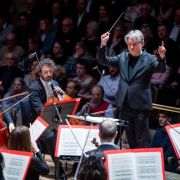
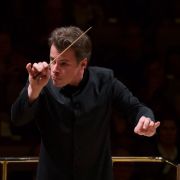
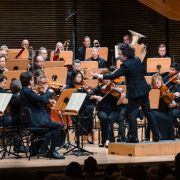
Marin Alsop conducted the Philadelphia musicians through this with clarity and drive where necessary, and subtlety and finesse when called for. The first movement, for instance, is punctuated by three structural ritardandi, grinding the forward motion to a breathless halt before dashing off again, and they were absolutely perfect.


The concert began, however, with a startlingly disappointing rendition of Beethoven’s beloved Seventh Symphony. It was difficult to believe I was hearing this from Alsop and this orchestra. Textures were often muddy. Balances were off – the climactic horn entrances in the last movement were barely audible and timpani overpowered much of the first. Transitions carried no tension. Ensemble was spotty, the trading of motifs in the third movement noticeably not lined up rhythmically.
There were some bright spots. Alsop’s brisk tempo in the second movement brought out the sheen of the contrasting major key sections, and the strings in the finale were nicely manic. The woodwind choir in the slow introduction to the first movement sounded as rich as expensive cake.