In his six years as Principal Conductor of the BBC National Orchestra of Wales, Ryan Bancroft has brought reliably imaginative and adventurous programmes to the BBC Proms. Thursday night’s concert followed suit with a quartet of pieces, composed between 1888 and 1933, evoking the passage from life to death, and what may await us on the other side.

Sheer weight of numbers, from the combined forces of the BBC National Chorus of Wales and the London Philharmonic Choir, blurred the austere unisons of Lili Boulanger’s Vieille prière bouddhique, dispelling its potentially exotic clouds of mysticism, but the choruses also served to fill the space of the Royal Albert Hall as an improbably secular temple to be sanctified in pursuit of nirvana. Tenor James Way made much of his small part in the prayer’s third verse, with a strongly projected but well-floated contribution.


Given its complexity as well as unfamiliarity, the Stabat Mater of Karol Szymanowski probably consumed the lion’s share of rehearsal time, and this performance gave every sign of fastidious preparation. Bancroft’s measured tempi and restrained dynamics persuasively evoked a peculiarly Polish kind of pale and fervent spirituality. Szymanowski’s suspended harmony pulsed with a subdued but glamorous piety: think Hedy Lamarr praying the Rosary in the front pew of a cavernous empty Catholic cathedral, backlit by Jean Renoir.
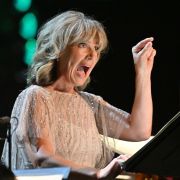
In her starring role, Mari Eriksmoen underlined such an impression with her ethereal and notably un-Slavic soprano. Paula Murrihy’s mezzo complemented her well; in the work’s brief louder passages, the contributions of baritone Szymon Mechliński were doubtless idiomatic but almost inaudible from my seat in the stalls – but that’s the Albert Hall for you.

In theory at least, the concert’s second half presented a provocative juxtaposition of early but preternaturally confident visions of the hereafter as drawn by Olivier Messiaen and Richard Strauss: the unshakable faith of one, against the equally determined atheism of the other. In practice, such a piquant contrast was muted by both approach and execution.
The nobility of Messiaen’s brass-chorale writing in the opening movement of L’Ascension was compromised by poor ensemble, with the first trumpet suffering a torrid six minutes. In the would-be radiant finale, the BBC NOW’s string section imparted both unwelcome tension and an alien, erotic intensity to Messiaen’s perilous stairway to heaven, evoking (probably by coincidence) an archaic tradition of much quicker performances led by early believers in the work such as Leopold Stokowski.


The sense of idiom was more confidently projected in the central movements of L’Ascension, and in the closing account of Strauss’ Tod und Verklärung. Bancroft never dwelled too fondly on the episodes of languorous retrospection that can make the work sticky, and integrated them with the outbreaks of anguish in a struggle of life forces which prefigured the dying Gerontius of Newman and Elgar. Again, it was probably an acoustic quirk that amplified the gong strokes marking our protagonist’s passing, and so raising an unlikely comparison with the ritualistic tread of Messiaen’s Et expecto resurrectionem mortuorum.