The three young composers featured in the Britten Sinfonia’s showcase at Kings Place are artists who do not mince words about their artistic aims, which are to engage with the musical world on their own terms, for committed aesthetic and political ends. They all shoot from the hip, but not always with the assurance and accuracy to score perfect hits. Fortunately, the full-on support of a trio of master soloists and a crack ensemble came to their rescue and helped to deliver a programme which found favour with a decent-sized audience, where grey hairs were easily outnumbered by those of other hues.


Amy Brice declares herself to be a queer artist who “approaches the industry through a lens of rejection and claiming, offering instead a sense of playfulness and wit”. Her piece Soft Rebellion certainly has a sense of mischief about it, with gestural nods towards a misty pastoralism – not out of place in November. However, the deeply-embedded elements of pastiche, no doubt meant to be finger taps on the nose, were too overtly self-conscious and arch.
The title of Toby Anderson’s #itgetsbetter refers to a project set up in 2010 “to uplift, empower, and connect LGBTQ+ youth and prevent suicide”. He warns gay men that it is both his happiest and his saddest piece. Others, like me, are able to see that he is an artist who can be trusted; joy and melancholy do indeed sit back-to-back, in mutual support. The joy is of the hedonistic kind I imagine might be had on a dance floor swarming with hot bodies; melancholy might reference cold dark nights of the soul, but in both cases I can only guess.
Although Alpine Concertino sounds a little bit cheesy, it is in keeping with Jonathan Woolgar’s tongue-in-cheek attempted take-down of the mountainous associations of Austro-German composers. There are unmistakeable references to Mahler, Strauss and Wagner; some are knowingly close to direct quotation, others identify the sights, sounds and scents those composers incorporated into their works. Prominent in the latter is the odour of cowbells for which Mahler was excoriated for smuggling into the concert hall.


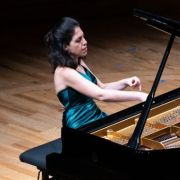
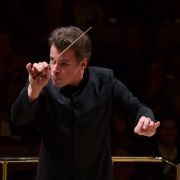
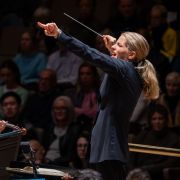
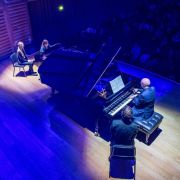
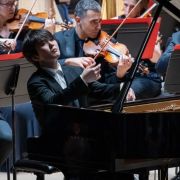
For the support which lifted the pieces to being more than the sum of their parts, cue Laura van der Heijden (cello), Martin Owen (horn) and Siwan Rhys (piano). In Brice’s piece, van der Heijden was an enthusiastic rebel, her rich tone and animato articulation lobbing floral grenades rather than custard pies. Owen enjoyed himself as a Valkyrie, Siegfried and Till Eulenspiegel, seamlessly matching his virtuosity and lyricism to Woolgar’s satirical demands. Rhys’ muscular energy carved a rugged location for Anderson’s dance floor, and the delicacy of her touch refused to be swallowed by the cloak of night. Drawing all that together was Tom Fetherstonhaugh who led the Britten Sinfonia with assurance, intelligence and flair. Kudos to them, and to all connected with the Magnum Opus initiative, which is such a vital platform for developing and showcasing new music in the UK.