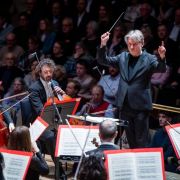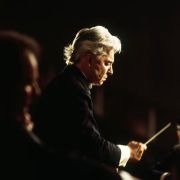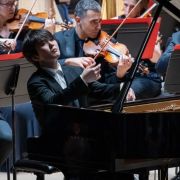


A programme of Beethoven and Mahler is usually guaranteed to leave one wanting more, and, for the most part, that was the case with the partnership of Karina Canellakis and Alice Sara Ott at the Royal Festival Hall. The distractions were the result of some of the dramatic elements of Canellakis’ interpretive aesthetic failing to achieve a safe landing in both Beethoven’s Fourth Piano Concerto and Mahler’s First Symphony. However, the playing of the London Philharmonic Orchestra, both in chamber mode and in epic formation, was as diverting as it was triumphant.


Ott, making her debut with the orchestra, gave an assured performance of the concerto, balancing intimacy with urgency. The delicacy of her opening bars found an echo in the slow movement where the anger and agitation of the strings deferred, as they always do, to wise counsel. This was a moment of fragile tenderness, which is such a feature of Ott’s artistry. In the outer movements Canellakis drove the accentuations in the strings so forcefully they tore into the fabric of the sound, and rather disfigured the composer’s sonic intentions. Nonetheless, the exuberance of the closing paragraph brought to the fore the eye-level intimacy of all three parties.
Canellakis’ fascination with Mahler led her to insert into the symphony the Blumine movement discarded by the composer. She has described it as a “droplet on the petal of a flower” but it functioned here as a detour off the main track of the work. It ventured not into the countryside for a lingering look at the birds and the blooms, but into an urban landscape where the over-ripe sound of the solo trumpet summoned up a whiff of the Coronation Street theme tune. More than that, it intruded into the established form of the work and was reminiscent of one of those strange ‘fourth plinth pieces’ which regularly adorn the unfinished corner of Trafalgar Square.


As a result of that intrusion, the opening bars of the Scherzo did not benefit from the abundant energy generated by the super-charged ending of the first movement, but it did achieve lift-off and danced merrily in the sunlight. The cousins Frère Jacques and Bruder Martin, both dressed in funeral garb, were more than once distracted from their solemnity by the startling appearance of the Klezmer band which wore its swagger with aplomb. As for the finale, the indiscretion of the Blumine episode was almost effaced by the sure-footedness of Canellakis’ interpretive acumen. This was high-octane Mahler served up in style, with studied attention to the details, demonstrative transition between sections, and the startling foregrounding of the brass-heavy rhetorical flourishes. At the close the usual gifts were proffered: horns on their feet, bells in the air; the woodwind in proclamation mode; the strings a whirlwind of joy; and the percussion fearlessly crashing the party. A reminder, if such were needed, that the orchestra was Mahler’s instrument.