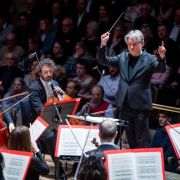
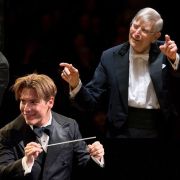
For this innovative program at Carnegie Hall, Budapest Festival Orchestra Music Director Iván Fischer brought together three pieces by composers of different nationalities and highly contrasting styles. Joining ‘Pärt at 90’, a worldwide celebration of minimalist composer Arvo Pärt’s 90th birthday, the evening opened in a surprising fashion with the 70 or so BFO musicians laying aside their instruments and moving downstage to sing Pärt’s Summa (a setting of the Latin Credo) in its original a cappella choral version from 1977. Shaped by Fischer’s understated conducting, the remarkably clear voices of the players created a calm, contemplative atmosphere, which made an immediate and intimate connection with the audience.


Maxim Vengerov was then the soloist in Tchaikovsky’s Violin Concerto in D major, giving an inspired performance, navigating the piece’s notorious technical difficulties with extraordinary ease and displaying an unusually wide dynamic range. His virtuosic playing was most breathtaking in the first movement cadenza, delivered with startling speed and masterful control. The central Canzonetta was marked by soulful Russian feeling and the exuberant finale, played with wonderfully crisp articulation, was replete with sparkling energy and light. Fischer and the BFO musicians provided totally responsive support, especially in key woodwind moments such as the flute’s exposition of the main theme in the opening Allegro moderato movement and the melodic back-and-forth between soloist, flute and clarinet in the second. Vengerov rewarded the audience’s enthusiastic ovation with an encore: a profoundly reflective, spontaneous sounding rendition of the somber Adagio from Bach’s Violin Sonata no. 1 in G minor, BWV 1001.

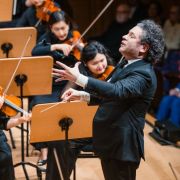
In the second half of the evening, the music moved away from Tchaikovsky to the opposite end of the Romantic spectrum with a lyrically fresh and textually transparent account of Brahms’ Second Symphony. Conducting from memory, Fischer demonstrated absolute command of the score, using modest but purposeful gestures and arm movements to highlight woodwind and brass details often buried in thicker interpretations. The BFO strings, seated in a traditional antiphonal layout (with the second violins to the right of the conductor) produced a rich, silky sound throughout the piece, most noticeably in the second movement Adagio. The Allegro grazioso third movement, with its graceful woodwinds had an appealing, chamber-like clarity. The finale, while less ferocious and fiery than usually heard, made a memorable final impression with its brass-powered, joyfully triumphant coda.


As an encore, violinist Kádár István, violist Szabó Andras and double bass player Fejérváei Szolt moved to the front and center of the orchestra to play a medley of increasingly fast and fervid Hungarian folk tunes from the Kalotaszeg region in Transylvania. The high-spirited fiddling moved the audience to break into rhythmic clapping at some points and brought the evening to a cheerful and satisfying end.