The story of Semele is not complicated, but when one starts reading the interviews for this Dutch National Opera production, familiar topics – gender relations, feminism, marriage – appear on the horizon. Would this opera become another vehicle for a pre-set thesis? That worry turns out to be unnecessary. Claus Guth’s production keeps Ovid’s mythological tales of gods grounded in a visceral domestic drama, brimming with contemporary humanity. The set design is as clever as it is cost-effective: the primary space is a grand, high-ceilinged reception lounge. Flooded with bright yet clinical light and framed by classical columns and ornate mouldings, this pristine white environment projects an air of cold grandeur. The actors are dressed in soft pastel shades – powdery pink, mint green and pale blue – adding a domestic softness.

However, the presence of the Jupiter, as an eagle, is omnipresent. Through video projection, the bird’s image intermittently appears at the front of the stage. Dark feathers drift from the ceiling like a haunting inversion of Jupiter/Zeus’s “golden rain”. In the production’s most dramatic shifts, these feathers descend in thick, ink-like clusters, bleeding into the white room as his menace and erotic threat. In other scenes, the fabric envelops the stage almost entirely, leaving only hollow voids at its centre in which Semele runs in futile circles, trapped in a labyrinth of her own making in pursuit of eternity. A massive crystal chandelier rises and falls throughout the performance, serving as the visual link between scenes.


Musically, the overall standard of singing and acting across the ensemble was highly satisfying. Guth’s staging places considerable physical demands on the performers, pushing them close to their bodily limits – there is no shortage of sweat, and one can only hope everyone knew exactly what they were signing up for.
The title role of Semele is vast, and Elsa Benoit traced the character’s path from innocence through seduction-fuelled dissatisfaction to final remorse with clarity and emotional credibility. Her portrayal felt both grounded and richly expressive, allowing Handel’s music to do the essential psychological work. Opposite her, Jakub Józef Orliński’s Athamas was notable for its spontaneity and exceptional vocal control. His brief dancing and acrobatics in front of his rival, including backflips, were impressive and fully integrated into the drama, never feeling like a stunt inserted for applause.

David Portillo offered a fresh and unsettling Jupiter. If his god lacked the traditional Olympian authority, he instead suggested a transgressive middle-aged man deliberately lowering himself to seduce a younger woman, complete with barely concealed jealousy toward Athamas. The interpretation was psychologically plausible and vocally compelling, adding a disquieting realism to the divine figure. As his wife, Jasmin White’s Juno initially felt slightly over-cautious in her first one or two arias. However, she ultimately established a convincing portrait of jealousy and calculation, and the character’s malevolence gradually sharpened into focus.

Florian Boesch moved effortlessly between Cadmus’s authority and Somnus’s absurdity, while Ino, though limited in stage time, functioned as a crucial emotional hinge. Nadezhda Karyazina handled both the role itself and Juno’s impersonations with notable precision. Iris, too, was neatly sketched, with Jessica Niles capturing precisely the air of an accomplice rather than a neutral messenger.


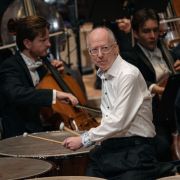
The orchestral playing under Emmanuelle Haïm and Le Concert d’Astrée was consistently outstanding for its sense of internal tension and forward motion. The basso continuo articulated harmonic turns with muscular clarity, keeping the drama in constant motion. This approach gave the entire evening an unusual sense of compression: the nearly three-hour performance passed with striking speed and concentration.

Ultimately, this Semele succeeds because it keeps the drama firmly grounded in human emotion and contemporary reality without forcing any ideological framework onto it. Handel’s music remains the primary means of characterisation, and the singing – together with full-bodied theatrical acting – stays at the very centre of the stage. At this point, one cannot help congratulating Handel for veiling the opera’s seductiveness in Puritan London 300 years ago.
Mengguang’s press trip was funded by Dutch National Opera