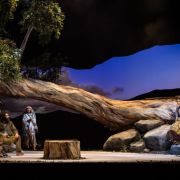
Bruno Bettelheim’s Uses of Enchantment had much to do with the late Elijah Moshinsky’s thinking when he devised this production of Hansel and Gretel in 1992. It justified British designer Mark Thompson’s puzzling replacement of the forest in which the siblings get lost by an exploded version of their own house. For their mother’s anguish about the family’s poverty has diminished her mothering and the kids’ comfort at home has become a challenge to be confronted. Facing that challenge will require them to find solutions of their own via cooperation.

Did Humperdinck have any of this in mind, I wonder? And did an Opera Australia still lacking an Artistic Director need to revive a 33-year old production with an all-Aussie cast and a revival director who almost certainly never saw the original? For the 39-year old composer was expanding on a series of song settings by his sister devised as entertainment for her children, using German folksong tunes and a lathering of Christianity. Maybe not so much Bettelheim, but plenty of the technical and harmonic language of Humperdinck’s mentor Wagner which, married to a simpler melodic line, caused the opera to get 50 productions across Germany in 1893, its first year.


The Opera Australia Orchestra under the company’s Head of Music, Tahu Matheson, seemed to reflect that history from the statuesque, brass opening of the prayerful overture with its whiff of Tannhäuser, even Parsifal, to the light and playful songs the kids take with them into the forest. For the overture, though, Moshinsky obviously didn’t subscribe to the contemporary tendency to provide illustrative action during any of the opera’s substantial orchestral passages.
After that strong introduction to the music, Margaret Plummer’s delightfully boyish Hansel and Stacey Alleaume’s provocative Gretel offered lively sibling rivalry. But don’t miss early reference to their father’s prayer in the face of real hunger, balanced by their mother’s desperation after she’s sent them to the forest to collect berries that she might not be able to save them from starvation.

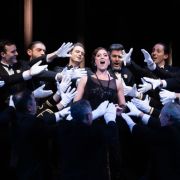
Both Shane Lowrencev’s lusty father and Helen Sherman’s bifurcated stepmother inhabited their parts fully, adding plenty of emotion after he has brought up tales of the Spittle Witches who live in the woods and roast the children who fall into their hands. In the woods, Allaume’s vocal power and Plummer’s boy bravery seemed almost unnecessary as the Sandman overcame their fears of the night, angels coming to their bedside, and a potential shared nightmare of a picnic, in which their real mother dies, is eased at their awakening by a hilarious troupe of Dew Fairies. By then, Grimm has been obliterated and Bettleheim diminished.


Which left the picnic’s birthday cake to become the witch’s house, from which Jane Ede emerged looking the part but lacking the degree of both sugar and spice wanted to match her magic tricks. Suddenly she was in the oven, which blew up splendidly to produce a fine gingerbread cookie in her image. Catharsis was lacking, though the final choral rendition of the Evening Prayer just about brought us home.