Honoring the 250th anniversary of the USA, the Kansas City Ballet played up patriotic themes in its spring showcase. There have been occasional attempts to marry ballet with nationalism (in France, UK, the Soviet Union and Mexico for example), but surely none quite so satisfyingly fun, so unabashedly cheerful as George Balanchine’s Stars and Stripes, created in 1958.

We don’t always need subtlety: sometimes, we just want entertainment, and what better than the rousing music of John Philip Souza to shelve all the complexities. I’m not American myself, but my children are, and they found the balletic spectacle as thrilling as any civic parade, especially seeing the flag rise up at the end behind the dancers.
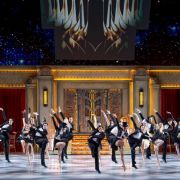
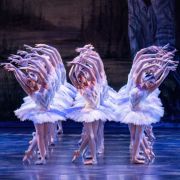
Balanchine’s ruse is, besides, actually quite a clever way to bring together worlds that seem ostensibly so far apart – the military (hard power) and the ballet troupe (soft power?). Yet, as Balanchine calls up the various regiments of dancers, are they so far apart as we might think? His work invites a comparison. Discipline, order, patterns, uniforms, coordinated movement – in tight formations where the individual is subservient to the collective – yes, one can see the parallels. A ballet corps and a military corps : the same word describes both.


Tonight, the timing and movements of the dancing regiments were sharp, punctual, pointed and precise: a pleasure to watch. The costumes were shining and polished. The white socks and the white gloves were especially nice touches.
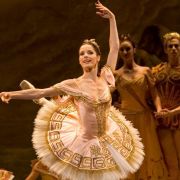
Naomi Tanioka and Paul Zusi paired attractively as the soloists, Liberty Bell(e?) and El Captain. The former moved with crisp and sculptural precision. The latter has great timing, elastic legs and brings a whip-sharp energy to his performances.

Americana was also in evidence in the first item on tonight’s bill: Agnes de Mille’s Rodeo, first staged by the Ballet Russe de Monte Carlo in 1942. What must have been exotic for the Ballet Russe was native here to Kansas City and indeed, it has often struck me, when attending an actual rodeo out west, just how theatrical and choreographed a display it is. Ballet for cowboys. And here, dancers lent into the whole cheeky foot-tapping, horse-jumping, leg-straddling, arm-swinging essence of the thing. What’s not to love? Copland’s marvelous score undergirds all the antics (none of which are en pointe). In the opening, the orchestra needed to be louder and brasher: more over-sized. But it came alive in due course.

It’s a piece to sit with too; the narrative suggests a depth about the act of dancing itself. Cowgirl, performed with caricatural fun by Marisa DeEtte Whiteman, is useful, but not ornamental (like the other ladies), and is consequently slighted, as a romantic partner, by the cowhands. At one point, she performs a shadow waltz-dance, as she yearns to do the kind of dancing she’s not made for. But champion roper Gavin Abercrombie is there to convince her that she can (and must) dance her own way: hence the famous Hoe-Down. An inimitable anti-ballet pas de deux, and what a pas de deux! They clearly enjoyed every moment of Western wildness.


At the center of the program was Caili Quan’s A Home Away, a world premiere for seven dancers, a compelling work of great purity of form and line. The aesthetic was cool but not cold: the white wide-leg pants for both male and female dancers added to the flow of movement, courtesy of costume designer Christine Darch.

It occurs to me often just what a great choice it is to back contemporary ballet with older music. There are various reasons why it works well, but one surely is that we can focus intently on the newness of dance forms, when not everything is new. I was also wondering tonight if there was something deeper at work too. The modern body (post-industrial, post-modern) seems, more often than not, imbued with a certain existential angst. Many contemporary choreographers, feeling this intuitively, present pieces that score somewhere (often high) on the angst scale. Even in Quan’s fluent, beautiful A Home Away, we feel the traces of this in the straining bodies, the pullings apart, and indeed the ultimate peeling off and dissolving into nothingness. But choosing to pair it all with extracts from Antonin Dvořák’s string quartet, The American, and an orchestrated version of one of his piano waltzes, helped to scale down the angst, so that we felt actually soothed and lulled by the beauty of the fluid, lithe movements. Even the final dissolution felt peaceful rather than traumatic.