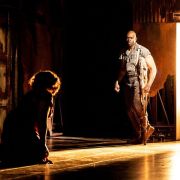
Carlisle Floyd’s Of Mice and Men is not an easy opera. Far from it. But it’s one of that sits with you – even burns into you afterwards. It’s not about ‘enjoying it’; rather it’s about finding it meaningful. Director Kristine McIntyre’s production for the Lyric Opera of Kansas City, enhanced by evocative singing, Kara Harmon’s brilliant costumes, Kate Ashton’s clever lighting and Luke Cantarella’s deft sets didn’t disappoint.

If a classic tragedy is about the fall of a person from ‘high estate’, this is not one. In John Steinbeck’s 1937 novella, the males are already the ‘deplorables’: wave upon wave of migrant workers that form part of California’s history, who end their lives as they began, emotionally as well as socioeconomically destitute, living under odds they can never hope to overcome.
Floyd’s music, like Steinbeck’s narrator, is omniscient about all of this. With Joseph Mechavich wielding the baton, the orchestra caught foreboding in every rhythm, in every alignment of instrumentation, every interval (lots of open fourths and fifths). Music, you could say, gives the story away from the start. Or the frequent injections of anti-music. The first sound we hear indeed is a discordant siren. Vulnerable men are being hunted. The orchestra was at its most convincing in the most cinematically pacy moments.


Another composer might have allowed us to be lulled by the beauty and innocence of man-child Lennie Small and the endearing co-dependence of Lennie and George Milton’s relationship in a hardscrabble world. One could certainly have imagined in another composer’s hands a lush, indulgent lyricism, even sentimentality, at times. Not Floyd. His soundscape keeps you on psychic alert from the very start.

Floyd therefore expects a lot from his audience. He wants us to sit in extreme discomfort for the duration. Mechavich’s job (and the cast’s) was not to let up. As Lennie, Matthew Pearce was excellent: a decent tenor (with plaintive high notes) complemented by sensitive acting: he had all the tics, flapping arms, the rocking of someone with a crippling sensory disorder. But his desperate need, his touch hunger, allow the others around him to become more human, to dare to dream a dream. (The tragic irony is that his touch hunger is also unintentionally fatal).
Sara Gartland as the sole female, the unnamed ‘Curley’s wife’, boasted an electric shock of a soprano, in keeping with her brazen, but vulnerable character. Wayne Tigges as Candy was a strong bass baritone. In one of the most brutal moments of the whole opera, moments after they discover Curley’s wife corpse, he asks George if the two of them can still go in on the dream (minus Lennie). The answer is, of course, no; he was ever only a third wheel. His singing of a curse over the corpse was savage.

I loved the way the characters sang of hope in their dreams, especially in the duet between Lennie and John Moore’s George, but their polytonal music doesn’t allow hope at a sonic level. The unrelenting nature of this could get quite unbearable in Acts 1 and 2 – the only emotional counterpoint coming from the old dog and cute puppy on stage. By Act 3, I was convinced by the integrity of Floyd’s choices and was willing to forgo emotional respite in the interest of the final denouement.


It is a brilliantly conceived scene. When George and Lennie ritually ‘repeat’ their American Dream sequence for the final time, George has a gun in his hands and the others are baying off-stage for Lennie’s blood. When Lennie does see the little farm in his mind’s eye (and those rabbits), Floyd allows the orchestra to indulge in truly harmonic lyricism and the picture perfect farm in the video projection is saturated in colour. We ‘see’ it and ‘hear’ it just as he sees it. It’s beautiful, it’s vivid... but it doesn’t last. Another anti-music moment follows: the shot that kills the man-child, as colour bleaches from the projection. George is left rocking and clutching Lennie’s hat in his hands, paradoxically Lennie-like in his brutal sensory deprivation.

The mise-en-scène was altogether first-rate. The costumes presented a highly realistic Dorothea Lange look-book, from vintage denim to Candy’s baggy cardigan, cool-man Slim’s cuffed jeans, Curley’s wife’s floral dress, and the variety of hats. The bunkhouse was an authentic space, right down to the army-camp blankets.
There was a beautifully observed moment after they put down the dog. Candy has already retreated to his bed in despair, but now some of the other men fall in too, pretty much curling up into the foetal position. At that point, tenor David Pelino sings a moving ballad about “movin’ on”. After George shoots Lennie (like dog, like man), Pelino comes in again. But this time he doesn’t sing, he just hums the same tune. Sometimes, there are no words.