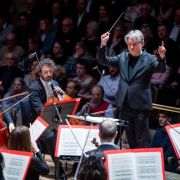
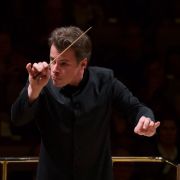
Nestled between the semifinals and finals of the Liszt Utrecht Piano Competition, Paul Lewis, Stéphane Denève and the Netherlands Radio Philharmonic Orchestra entertained a large and lively audience at TivoliVredenburg’s Grote Zaal with a program of Beethoven, Liszt, and Schumann that, intentionally or not, invited reflection on long-range musical continuity. The audience itself was marvelous: all age ranges present, teenage couples on dates, young adults clearly enjoying a night out with classical music, a seeing-eye dog lying watchfully at the feet of its master.

Lewis opened with Beethoven’s Fifth Piano Concerto, a work that already points toward continuity, with cadenzas absorbed into the musical flow and the final two movements linked without a break. Lewis swept fluently through the opening, setting a rhythmic pulse into which the orchestra responded with fire and enthusiasm. The horns were gloriously golden and lyrical, and Lewis showed split-second timing in his phrasing. The double basses and cellos shaped – even phrased – their parts, and overall orchestral balance was good with the woodwinds, though the bassoon could have been brought forward more, an issue that would recur throughout the evening.


As the movement progressed, Lewis became more percussive, clattering into octaves; still, there was a simple poetry in his playing to compensate. What the movement lacked, however, were larger imaginative arcs. After the cadenza the music did not quite release and tumble forward, despite the horns crooning magnificently in their thirds. Toward the big final climaxes, woodwinds — especially the flute — were not easy to hear, and the sense of mystery at the end felt underplayed. The finale proved less interesting than it should have been, and Denève turned the last page theatrically as if uncertain about how it was going to end.
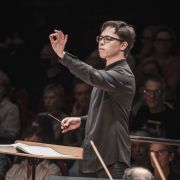
After the interval came Liszt’s Les Préludes, by which point the seeing-eye dog had fallen completely asleep — no more “His Master’s Voice”. Denève showed himself to be a conductor who likes to conduct even the smallest solo, shaping every detail. Players in the back ranks reached for earplugs as the percussion array prepared to unleash cymbals, timpani, bass drum, and snare drum. The effect was exuberant and noisy, like the score to the ancient Flash Gordon serials from the early days of television. It was lots of fun, but, heard after Beethoven as an evolutionary endpoint of that vision, the music itself emerged as a rather blunt instrument.
In Schumann’s Fourth Symphony, which closed the program, Denève took no repeats, let the subtlety of the pauses slide and allowed the second movement simply to happen. The concertmaster's solo was barely audible, even when playing on his own. Neither conductor nor orchestra seemed fully comfortable with one another in the scherzo, and the not-very-dramatic segue into the last movement failed to generate real tension. Even so, this did little to detract from the impact and the audience's enjoyment of the work’s miraculous originality, beauty and passion.


The evening ultimately offered more food for thought than organic persuasion. Continuity was everywhere in the program’s design, but less convincingly sustained in performance, reminding us that long-range musical thinking on the page still demands long-range imagination in the hall.