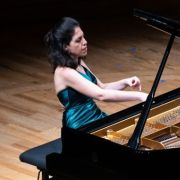
This concert marked the Orchestre de la Suisse Romande’s first visit to the Elbphilharmonie, nearly a decade after the hall's inauguration. They arrived with two big treats and a soloist of immense stage presence, Khatia Buniatishvili, ready for the programme which demands of Herculean strength.

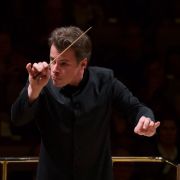
In the first half, Jonathan Nott treated Debussy’s Images with a watercolourist’s spontaneity and transparency, underpinned by surgical precision in modernist textures. The result was like a series of rapid outdoor watercolour sketches – translucent, vivid and breathable. The sense of light throughout was extraordinary: sharp, fresh and fleeting. Overall tempi were slightly swifter than usual, ensuring a fluid, atmospheric experience. Particularly impressive was Ibéria, where the woodwinds carried a bright, tart timbre, while the brass displayed a sense of restrained wildness. Nott, acting like an expert gastronome carefully ‘plating’ orchestral colours rather than serving a feast of sonic saturation, navigated the rhythms with such nuance that the air seemed scented with the streets of Southern Spain. The strings’ pizzicatos leapt like guitar strings or dappled sunlight through the hall. Equally notable was the transition from the second to the third part of Ibéria, executed with such controlled poise and superior musicality that the shift felt as natural as a change in the wind.


After the intermission, Khatia Buniatishvili took to the stage for Brahms’ Piano Concerto no. 2 in B flat major. Her performance was a demonstration of personal touch and structural integrity, though her unique voicing initially required the listener a moment of adjustment. It did not provide the clinical, high-fidelity sharpness or granular edge typical of modern digital aesthetics. However, her true character lay in her sound with a profound, mellow texture, reminiscent of the frosted light bulbs atmosphere of the 1930s LP Golden era. It was an aged, full-bodied tone, rich with a quality that invited deep contemplation. From a featherlight ppp to an earth-shaking fff, her dynamic range was handled with effortless ease. Most impressive was the unwavering stability of her physical frame – from arm to palm – which provided total tonal control even in the most volcanic passages.
It was a performance brimming with humanity and improvisational sparks. The interpretive path taken emphasised the vivid character contrasts between the four movements, as well as the flashes of spontaneous inspiration within them. Nott maintained a delicate balance, transforming the symphonic scale of the work into the shared confidence of a private conversation. The OSR followed Buniatishvili’s lead with exceptional sensitivity, their strings providing a warm, velvet cushion. Although this interpretive approach more or less ‘salonised’ Brahms, it did so in the most elevated sense. It felt like a deep, elevated memory of Brahms’ own nocturnal experiences in Hamburg – a sublimation of his youth translated into mature musical thought. The chemistry between soloist and orchestra was profoundly intimate, particularly in the third movement, where Buniatishvili’s piano melted into the soulful lines of the principal cello.


The generosity of the performers was boundless. Not content with a mere bow, they treated the audience to three encores. After two Liszt pieces, the final piece – a Fauré duet between Buniatishvili and the principal cellist – served as a poignant coda. This was, in every sense, a night defined by the beauty found in the tangible, sensory world and authentic human connection. In an era of spotless digital aesthetics, it felt like a dream-like window into another time.
This concert was promoted by DK Deutsche Klassik