There’s not a composer who wouldn’t give their eyeteeth for the kind of treatment Ondřej Adámek’s Thin Ice received in its premiere by the Prague Radio Symphony Orchestra. With conductor Jonathan Nott on the podium crafting expert soundscapes, violin soloist Christian Tetzlaff showing technical wizardry and the orchestra players turning in a razor-sharp performance, it was an impressive debut on every level.

Billed as a concerto, Thin Ice deconstructs the form and then reassembles it as a sonic assault that opens with sharp, repeated pizzicato on the violin backed by slashing lines from the orchestra and never lets up. It’s as if a standard concerto had been fed into a mechanical thresher that turned it into metal. In particular, a rhythmic passage following the opening offers a perfect realization of a factory, with knocking, clanking and whirring sounds coalescing into a cacophonous melody. Much of the remainder of the piece plays out like the orchestra and soloist are having a competition to see who can produce the most outré noise.


And it’s glorious noise, wildly inventive, cleverly orchestrated and thoroughly refreshing. With unorthodox changes in tempo, tone and dynamics literally every few bars, it takes a master hand to pull it off, which Nott did with aplomb. He elicited an exceptionally tight, disciplined performance, drawing out fine details and surprising expression from the tumult. The orchestra is asked to sound like a calamitous train wreck most of the time, and to render that with integrity and impact that is entertaining rather than devastating is a remarkable accomplishment, especially for a visiting conductor.
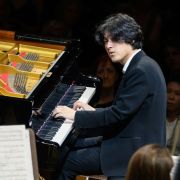
The demands are no less severe on the soloist, who alternates between complex runs played at a fever pitch and soft solo passages that call for unusual techniques, one or two apparently invented just for this piece. At one point, Tetzlaff was strumming his violin like a guitar. He handled it all with a masterful combination of skill and brio, deeply focused on every note, passionate in execution and totally unfazed by the technical challenges. It was a showing that merited basking in applause, but Tetzlaff’s first move after finishing was to look for Adámek in the audience and invite him onstage to share the limelight.

The evening opened on a much more soothing note with Mahler’s Blumine, originally a movement in the composer’s First Symphony that he decided to excise after stinging criticism. It was rediscovered in the 1960s and is now a warm, evocative standalone piece portraying lovers meeting on a moonlit night. Nott treated it gently, teasing out the melodies and rendering the dialogue between the trumpet and oboe with refined clarity. Whisper-soft strings gave the piece a radiant glow.


Zemlinsky’s symphonic poem The Mermaid closed the evening in the same vein, with Nott giving lush, glimmering treatment to a piece that never seems to decide whether it’s romantic or modern. It had a powerful visual quality under his baton, with considerable finesse in his use of the brass to paint colors and satin strings that approached transcendence in the final movement. There was both energy and grace in his flowing interpretation, which nonetheless felt anticlimactic. With all due respect to both the conductor and composer, after the mind-expanding experience of Thin Ice, even the finest of traditional works would have seemed tame by comparison.