It wasn’t until the fourth evening of the 2026 Pärnu Music Festival that the audience was able to hear a full-throated symphony orchestra in full flight. It was worth the wait. Up to that point the creative team had flexed its collective muscles with Neeme Järvi’s youthful band of musicians the Järvi Academy Festival Orchestra, with an evening of debutant conductors at the helm of the Järvi Academy Sinfonia and by Kristjan Järvi’s arch-experimental Solstice.

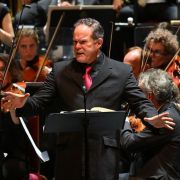
The third member of the home family, Paavo Järvi, finally made it to the podium on Saturday with a sumptuous programme that brought the impressive Pärnu Concert Hall to its collective feet, a routine act of appreciation at this address but one that on this occasion transcended the commonplace. Järvi’s account of Nielsen’s ambitious Sinfonia espansiva was mightily thrilling, a reading of grandeur and glory that will live long in the memory.


The Estonian Festival Orchestra casts its net wide in recruiting a crack band for this annual celebration of music in general and Estonian composers in particular. The nickname of Nielsen’s Third Symphony was intended to indicate outward growth, but the more literal meaning of ‘expansive’ also fits the bill, especially in the epic outer movements. Nielsen starts with a cornucopia of aural thrills, then surprises the ear by opening the second movement with a motif redolent of Mahler’s first Nachtmusik (from the Seventh Symphony) which gives way in turn to a wordless segment for female and male soloists. Järvi placed the singers (baritone Tamar Nugis and the seraphically pure-voiced soprano Sandra Laagus) antiphonally at the distant extremes of his divided violins.
Gabriel Fauré, so often pigeon-holed as a miniaturist, was also capable of grand musical gestures, and the Estonian conductor’s love of an ambitious symphonic arc found its natural home in the Suite from Pelléas et Mélisande. Since this opened the concert its Prelude was the first thing the audience heard, and its elaborate construction proved as stirring as anything the French composer wrote. The famous Sicilienne subsequently emerged in a reading as courtly, stately and romantic as any I can recall.


Home-grown repertoire was represented by Tõnu Körvits, perhaps the best-known living Estonian composer apart from Arvo Pärt and on this showing another master of symphonic writing. His viola concerto, Secret Garden, was both immediately appealing and entirely convincing. This handsome, three-movement composition was deeply considered music whose every note made its mark. Its lengthy first movement, Song of the Wind, paid apparent homage to the Violin Concerto of Alban Berg, its fragmentary opening a companion to that work’s gentle beginning. Soon, a torrent of nervy arpeggios from the virtuoso soloist, Ahimai Grosz, was leavened by an insistent harp ostinato before giving way to Song of the Light, a movement of a sweetly personal lyricism, and finally to Song of the Night, in which Grosz’s viola seemed to rise then fall in flight. ‘The Owl Descending’, perhaps.
Mark's press trip was funded by the Pärnu Music Festival