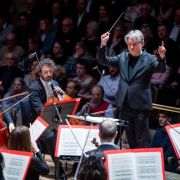
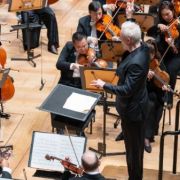
When Vasily Petrenko comes to Singapore, expected the unexpected. That dictum held true again when he conducted the Singapore Symphony Orchestra in local premieres of two Soviet-era works. The first was Estonian composer Arvo Pärt’s Our Garden (1959), a cantata for children’s choir and orchestra, created way before the sacred minimalism for which he became celebrated. Its very pleasant 12 minutes in Estonian was sung from memory by 49 members of the Singapore Symphony Children’s Chorus. The childlike innocence and concordant tones in four short movements revealed a Communist message, about how hard work yielded rich crops of juicy berries. The only hint of dissonance came when exhorting that weeds and thistles should be removed for consuming too much water. The secrets of making this garden grow was far less Voltaire but much more Marx and Engels.


Following this was a breezy reading of Camille Saint-Saëns’ Cello Concerto no. 1 in A minor by French cellist Gautier Capuçon who shone with a rich and sumptuous tone throughout its too-short-by-half single movement. The requisite virtuosity was balanced by gently traipsing daintiness in the Allegretto con moto central section. As if to make up for its brevity, Capucon’s encore of American composer Bryce Dessner’s Towards The Forest, commissioned as part his Gaia project, was a series of long-breathed arpeggios and drones.
The much longer second half was devoted to Shostakovich’s Symphony no. 4 in C minor. Its long-awaited local debut was in large part due to considerable logistical issues, a sprawling work calling for over 120 players, including multiple woodwinds and brass, two harpists and nine percussionists. Even the late Gennady Rozhdestvensky demurred on the idea, but it was fair game for Petrenko, whose programming was a coup of sorts. The Socialist Realist paradise of Pärt’s Our Garden now came in stark contrast with the Socialist Realist nightmare that was this Mahlerian behemoth.
Composed in 1936 but only first performed in 1961, Stalinist artistic strictures following the “Muddle instead of music” episode that was Lady Macbeth of Mtsensk could have put paid to the young Shostakovich’s career for good. What was one to make of the music’s wildly contrasting emotions? A more strident and brutal march that opened would be hard to find, with the orchestra ramping up decibels like no other. Yet within minutes, there were moments of stasis and relaxation, like a waltz-like second subject that completely changed the mood. Then out of nowhere came the infamous fugue for strings, a “fugue from hell”. The message was clear: Shostakovich was decrying a spoilt system and schizophrenic society.


The audience applauded the opening movement politely, later privy to the central movement’s quirky Ländler which closed with the bare bones of rattling percussion. This was followed by the finale’s monstrous funeral march and its grotesque cavalcade of instrumental oddities. Multiple opportunities were afforded for soloists to shine – Guo Siping’s bassoon, Allen Meek’s trombone and Andrew Beer’s violin to name just a few, and entire sections which responded with total commitment. Even the ending was ironic, a massive C major chorale the supposed apotheosis but giving way instead to an icy and desolate close. Death in the steppes. DSCH’s time has come in Singapore.