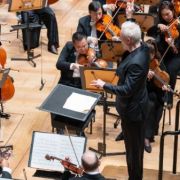
Let’s get this out of the way first. Wolfgang Amadeus Mozart (1756-1791) was a musical genius while Antonio Salieri (1750-1825) a skilled journeyman. The premise of Hans Graf’s final concert of his six-year tenure at the helm of the Singapore Symphony Orchestra was not just to compare the achievements of the two composers, but to ponder the gulf between hard work and divine inspiration, and how we live with both.

The evening opened with Salieri’s Piano Concerto in C major, from a rising 23-year-old who still had 52 years to live. The martial ritornello opening of the Allegro maestoso exuded the same vibe as Mozart’s K503 in the same key. Big chords paved the way for young pianist Adrian Tang’s clean and accomplished delivery, which lacked nothing in polish and purpose. The problem was how Salieri works his musical ideas and themes. While Mozart delights in variety and nuance, Salieri resorts to what virtuosi of their day did best, note-spinning and striving for effect. The development and cadenza had lots of that, and one soon tired of listening. The A minor slow movement had an opening solo resembling the corresponding movement of Mozart’s K488, but it fell short of Mozart’s combination of gravitas and elegance. The finale’s Rondo saw delicate and nimble fingerwork on display with passages of Sturm und Drang by way of contrast. While pleasant and euphonious to the ear, it proved ultimately unmemorable.


Mozart’s Piano Concerto no.14 in E flat major, K449, was premiered when the composer was 28, right at the cusp of greatness. What a contrast it made with the workmanlike Salieri. Young soloist Toby Tan did the honours, giving a dream performance of fluency and care for detail. He truly got into the spirit of Mozart, imbuing the score with a singing quality and en point articulation. The slow movement was a lyrical gift that kept on giving, milked for all its worth, while the finale’s theme and variations sparkled, going full buffo in a comedic coda for a final flourish. Both pianists, students of Albert Tiu, joined hands for a delightful encore, the finale from Mozart’s Sonata for four hands in D major, K381.

Rimsky-Korsakov’s one-act opera Mozart and Salieri, based on Pushkin’s little tragedy from 1830 and sung in Russian (with English surtitles), received its Singapore premiere. This piece of speculative fiction spawned an industry built on the scurrilous rumour that Salieri murdered Mozart. He did nothing of the sort, but judging by Russian bass Mikhail Svetlov’s self-pitying monologue as the industrious but pedantic Salieri, he might as well have done so. By poisoning the god-given genius of an irreverent and flippant Mozart, played by the much younger-looking Russian tenor Boris Stepanov, he was preserving hordes who bore the badge of mediocrity.
Rimsky’s is not so much a lyric opera in the traditional sense but a psychological melodrama that pits the earthbound against celestial talent; the composer was also comparing himself with the cultural giants that were Pushkin and Mussorgsky. A chamber-sized orchestra accompanied the action, and there were cameos by Matthias Oestringer as the blind street violinist and Adrian Tang in the pastiche piano part. Members of the Singapore Symphony Chorus, placed high in the balcony, sang the opening page from Mozart’s Requiem, as the musical rivals memorably walked into the pages of infamy. Graf’s final act as Music Director of the SSO could not have been more poignant.