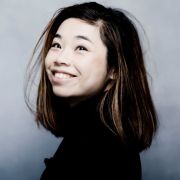
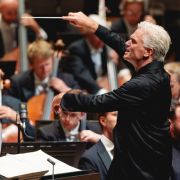
Few violin concertos soar from the first bar as Erich Korngold’s does, the solo violin covering two octaves in five notes. Ray Chen established the mood at once, rhapsodic but always within conductor Vasily Petrenko’s clear and firm beat, steady pulse and spontaneous passion collaborative, never contradictory. Petrenko’s programme note refers to Chen as “our friend” and that’s how it came across.

The tempo and temperament in the opening Moderato nobile seemed an ideal response to that elusive instruction on the score. Chen’s playing was vibrato-rich, a throb to suit Korngold’s warm melodic manner. He suffered a broken string at one point, an orchestral violinist quickly coming to the rescue to affect what Chen later called the “quickest ever string change” so that he was only briefly denied the use of his no doubt priceless 1727 Stradivarius. Yet using an orchestral player’s violin Chen seemed to produce as lovely a sound as before. One of the central London foot underpasses hosts a busking fiddler, whose take would quadruple if he lent his battered instrument to Ray Chen for half an hour!


Korngold’s 1945 concerto deploys themes from his film music, which has led to easy jibes; The New York Times’ reviewer derided it as “a Hollywood concerto”. Anyone who listened and thought, rather than sneered, could hear a Romantic’s reaction against what Korngold called “too much modernism”. It certainly has a Hollywood scale orchestra with a Technicolor range of percussion including bass drum, cymbals, gong, tubular bell, glockenspiel, vibraphone, xylophone and celesta – for a violin concerto! (Even Mahler did not need all that lot in the second half.) Three percussionists were deployed alongside the timpanist – and were kept busy at times. But the whole Royal Philharmonic Orchestra championed this concerto as if they believed in it. They certainly applauded Chen with enthusiasm, as did we all. An Ysaÿe encore was despatched with great aplomb.
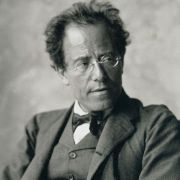
The concerto was dedicated to a fellow exile in California, Alma Mahler, the widow of Korngold's early supporter Gustav Mahler, whose Fifth Symphony contains his best known music, the fourth movement Adagietto. This movement was a love letter to Alma from her husband. It did not save their relationship, but has helped make Mahler one of the best loved and most played of any composer since the middle of the last century. Marked Sehr langsam (Very slow) it received here an eye-pricking performance of ineffable tenderness, Petrenko’s daringly broad tempo perfectly realised by the strings and harp (which is all Mahler needs). Music like this, played like this, is a paradox. Time, which in music is all about forward motion, can be made to stand still.


But the scale and scope of this mighty work of nearly 70 minutes makes for sonorous splendour, from the opening solo trumpet to the closing chorale and coda. The first movement Trauermarsch had the inexorable funereal tread, the dark origin of Mahler’s darkness-to-light design. The wild second movement, marked Stürmisch bewegt, mit größter Vehemenz was as stormy and vehement as directed, with a huge (unmarked but very effective) ritardando just before the coda accomplished by Petrenko’s clear command of his forces.
Ben Hulme, Principal Horn, was outstanding in the central Scherzo. Both he and Principal Trumpet Matthew Williams played impressively all evening, and the programme requires no less. Mahler gives neither player – nor any of his musicians – anywhere to hide. But the first desks of the RPO are all impressive these days, and the orchestra’s relationship with Petrenko is such that one has to ask “has the RPO ever made a better appointment?”