This Royal Philharmonic Orchestra concert belongs to the ‘Multitudes’ series which is, to paraphrase, the Southbank Centre’s “multi-arts festival powered by orchestral music, bringing together some of the world’s finest ensembles for collaborations with artists from different art forms…creating a new way to encounter the enduring power of classical music.” The music this evening was a single work, Messiaen’s Turangalîla-Symphonie, forming that title from two Sanskrit words ‘Turanga’ meaning movement or rhythm, and ‘Lîla’ meaning play or love. The composer said it was dedicated to “love that is fatal, irresistible, transcending everything, suppressing everything outside; joy that is superhuman, overwhelming, blinding, unlimited”. It forms part of what Messiaen called his ‘Tristan’ trilogy, with two other works of the 1940’s, the song cycle Harawi and the choral piece Cinq rechants.


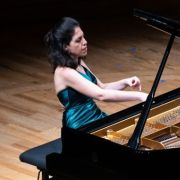
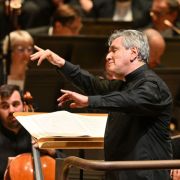
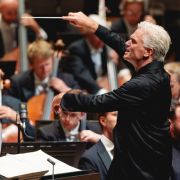
Turangalîla’s ambition implies scale, and the work’s 80-minute length has ten movements, eight with their own subtitle., such as the fifth movement – the lively Joie du sang des étoiles (Joy of the Blood of the Stars) – while the sixth shows the Jardin du sommeil d’amour (Garden of the Sleep of Love). The orchestral forces are expansive, the percussion including vibraphone, temple blocks, maracas and a Provençal tabor. There is a substantial solo piano role, played by Steven Osborne, and an ondes martenot, an early electronic instrument, played by Cécile Lartigau. The RPO, under Chief Conductor Vassily Petrenko, certainly filled the platform.
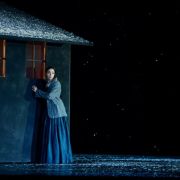
With such demands, Turangalîla is performed infrequently enough to make each occurrence a special occasion, often filling a concert programme on its own. This RPO performance, in line with the festival concept, was accompanied by an original silent film (with some text, in silent movie style, in cod ‘period’ English), created by 1927 Studios. The film was designed to match at least what we might call the larger rhythms of the music, acknowledging its big moments with some of its own. The suitable theme was clearly Tristan and Isolde, with the drinking of the wrong potion, a betrayal of a King, then a betrayal of the lovers by a villainous Melot figure. The style was irreverent, cartoonish at times, the villain grinning wickedly at camera, lacking only a pantomime waxed moustache to twirl as he guffawed. The animations were often jokey, where Messiaen’s solemnity and authenticity contain no hint of irony or self-parody.


Diverting for ten minutes – well, maybe – tedious over eighty minutes, certainly. So feature film length, but its frivolity reducing a serious composition to mere movie-house accompaniment to the big screen in movie-house gloom. At least just enough light was available clamped to the desks of the RPO players for them to play reasonably well, as did the soloists, Osborne especially impressive in his taxing part. The initial reception was only lukewarm for such a big occasion. This ‘Multitudes’ concept, did not this time meet its aim of “creating a new way to encounter the enduring power of classical music”. It can yet be made to work, but perhaps needs a rethink of the nature of the collaboration between film-makers and musicians, and a more dedicated response to the essential nature of the music.