There’s some corner of a foreign field that remains forever England. And so it seems here in Gstaad, Switzerland, listening to Daniel Hope playing the Elgar Violin Concerto. The Gstaad Menuhin Festival, where Hope is in his first season as Artistic Director, was started by its eponymous musical legend in 1957. Now marking its 70th edition, it boasts a summer academy with high-level masterclasses, an annually assembled orchestra and a variety of contrasting venues. After initial chamber music events in the fresco-rich church in Saanen, the chief setting in Menuhin’s day, Saturday night marked 2026’s first orchestral concert in the habitual big tent adapted from the local sports centre.


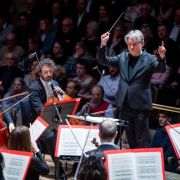
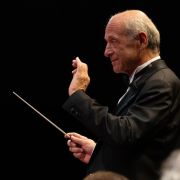
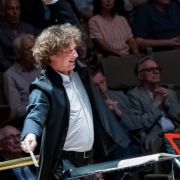
Alexander Shelley is a new figure on the Gstaad podium (Jaap van Zweden, the usual conductor, had a scheduling snarl-up), and comes over as personable, energetic and positive. He established a close partnership with Hope, accompanying attentively through this discursive concerto’s flexible canvas. Ironically, given the surrounding landscape, there were perhaps more high peaks and deep valleys than many would give this work, though a tendency to exaggerated slowing-down sometimes lent an over-ponderous effect.
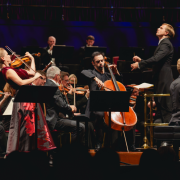
Hope drew a meaty sound from his 1742 Guarneri del Gesù and filled the solos with strong colours, whether in a skitter of up-bow staccato, a soar up to the stratospheres or a beehive of double-stopping. The team had their work cut out, however, against an ungrateful acoustic in which the orchestra frequently seemed too loud for the solos.
Beethoven’s Fifth Symphony provided the ideal second half, a punchy contrast to Elgar’s introspection. Shelley regrettably launched into that famous opening while the welcoming applause was still loud enough to obscure it; but what followed brought much to enjoy in terms of pace and character, culminating in a suitably exultant finale. As encore, we had a lickety-split account of Mozart’s overture to The Marriage of Figaro, with Hope playing in the first violin section.


This orchestra – drawn from full-time ensembles from across Europe, including Rotterdam, Munich and Lausanne – boasts distinguished playing from individual members such as the first oboe and bassoon, as well as an especially impressive cello section. A more consistently unified approach could have added impact, and it’s possible that Shelley is not accustomed to managing the vagaries of that acoustic (for which he certainly has my sympathy). A plan to build Gstaad a concert hall is reputedly underway, and it would make a welcome difference.
I’m not always keen on festival ‘themes’ – they can be albatrosses in waiting – and ‘Family Matters’ appeared to need some verbal explanation from the platform (though it was nice to know that the conductor’s father, the pianist Howard Shelley, was there to enjoy it). Nevertheless, a celebration of music’s power to bring us together never goes amiss, whatever the title. This magical mountainside music-making is no exception.
Jessica's press trip was funded by the Menuhin Festival Gstaad