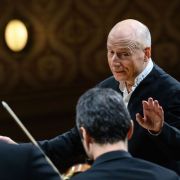
When Leonard Slatkin doing Beethoven sounds anticlimactic, you know it’s been a remarkable night at the concert hall. In a sense, Slatkin was his own competition. The esteemed conductor and composer has a longstanding relationship with the Prague Symphony Orchestra, whom he reconnects with periodically for a bracing blend of European and American music. On this occasion, the program opened with one of Slatkin’s own works, Schubertiade. The joy and spontaneity in that piece carried over to a virtuoso performance of Martinů’s Violin Concerto no. 1, and a rousing run through Beethoven’s Eroica Symphony.

Schubertiade is a narrative orchestral fantasia that imagines Franz Schubert trying to get some work done while constantly being interrupted by rambunctious visitors. It opens and closes with the composer at the piano, working out his B flat Sonata, and is interspersed with snatches of melodies from other pieces he wrote. But no melody survives for long, cut short by sudden slashes and jolts from the orchestra, or reworked with modern harmonics and rhythms. Hints of Eastern and African music and a big blast of street noise add surprises to the mix, lending the piece character and charm – there’s no telling what’s coming next.


While Slatkin’s admiration for Schubert is clear, the piece is less a homage than a knowing nod to a fellow composer. He gave it light-hearted treatment, almost whimsical at times, invoking the visitors’ increasingly drunken revelry while respecting the source material. The orchestra responded with alacrity, spinning out whirling dances, colorful melodies and interjections that hit like a hammer blow.
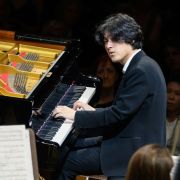
The Czech piece on the program was Slatkin’s choice, as was the soloist: Josef Špaček, one of the finest violin players in a country brimming with exceptional violinists. He turned in a riveting performance, handling the daunting technical demands of Martinů’s score with grace and ease, and firing off fierce, thrilling solos. The Andante gave Špaček a chance to show his tender side, and in an animated finale, he reeled off crisp, clear lines amid an avalanche of them. The orchestra provided a dynamic backdrop, with Slatkin setting a brisk pace propelled by rapid-fire percussion, and imbuing the music with the jazz flavor of the late 1920s. In all, it was a technical tour de force featuring a seamless fit between conductor, orchestra and soloist, as if they had all been playing together for years.

Špaček came back for an encore that was equally impressive, a brilliant rendering of the Danse rustique movement from Ysaÿe’s Violin Sonata no. 5. It had drama, flair, blistering technique and infectious energy that drew an enthusiastic response from the audience.


The Beethoven symphony mainly showcased the strengths of the orchestra – sensitive strings, expressive woodwinds, a high caliber of musicianship and a stylish way with melodies. Slatkin kept the emotional range of the piece relatively compact, never reaching too high or low. Its impact came from a strong internal pulse that barrelled through the first movement, retreated for the slow, solemn march of the second movement, then erupted in the third with irresistible momentum, driving the symphony to an energetic but well-balanced finish. If it was not full-blooded Beethoven, it was a polished, engaging treatment marked by precision in the playing and fingertip control of the sound.
Individual pieces aside, Slatkin has a chemistry with the Prague Symphony Orchestra that borders on magical and never wanes. Whatever the program, it’s always a treat to see that relationship renewed.