After a sui generis opening night with Le Grand Macabre, this year’s Musikfest Berlin moved on to its next operatic enterprise with another foundational title from the past century, placed at the opposite end of the repertoire spectrum from Ligeti: Gershwin’s Porgy and Bess. A complicated performance history in Germany – particularly Nazi-occupied territories during World War 2 – made this new semi-staged production by Chineke! Orchestra and Cape Town Opera particularly welcome, thanks to an all-Black cast. Palpable chemistry between the two leads, Siyabulela Ntlale and Nonhlanhla Yende, and conductor Enrique Mazzola is good reason alone why a trip to Antwerp or Dortmund, the next two dates of their European tour, may prove worthwhile.


Almost one century after its premiere, Porgy and Bess still presents some insoluble issues. A paradoxical, well-meaning product of its time, the opera has regularly offered Black singers a platform to perform, while risking ring-fencing them to this handful of roles. On a narrative level, its depiction of an impoverished Black community through the eyes of three white authors remains controversial, albeit vivid and sympathetic.
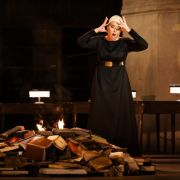
Cape Town Opera approached these contradictions with due sensitivity. Director Magdalene Minnaar and choreographer Yaseen Manuel use the limited space on stage to evoke a vibrant neighbourhood with costumes suggesting a time jump to the 1950s, far from the abjection of the post-Civil War slums that the libretto originally prescribes. Soloists and chorus join together in games and dance, and the grimmer moments in the plot are made less catastrophic, as if to project the light of the promisingly open ending onto the rest of the opera’s events. Actors move around confidently by virtue of natural, realistic blocking. Much positive can also be noted about what the directing team achieves with the lighting design, which creates a lively atmosphere around the singers and orchestra.

With scores like Porgy and Bess, omnivorous in their inspirations, a good balance between playfulness, composure and emotionality is as important as hard to maintain. Enrique Mazzola allowed every tonal and stylistic layer in Gershwin’s music to enjoy its time in the spotlight. For those of us more familiar with jazzy renditions of “Summertime”, Mazzola offered the chance to hear it in a new coating, closer to the blurred timbral hues of the Impressionists. Rougher, harsher sounds from the brass section tinged the performance with hints of Stravinsky, and swoony violin runs recalled turn-of-the-20th-century Italian opera. Thanks to the responsiveness of Chineke!, Mazzola made all these puzzle pieces fit together, with catchy, swung rhythms in brisk tempos as the common denominator. Dynamics inclined towards the forte didn’t seem to bother the singers, who had more than enough punch to rise above them.


Siyabulela Ntlale’s baritone sounded large, well-supported and perfectly melodic. His Porgy alternated from the light-hearted ease of “I Got Plenty o' Nuttin’” to several lyrical moments where his Romantic roots came to the foreground thanks to beautiful, spacious phrasing. Nonhlanhla Yende’s Bess was a worthy match, her introspective mezzo reliant on wistful legatos and pleasant vibrato, turned increasingly extrovert with the emotional development of her character. Among the supporting cast, Siphamandla Moyake’s Serena left her mark with a wonderfully sung “My Man’s Gone Now” where each ornament was incorporated in the vocal line with great melodic sense and intensity. Lukhanyo Moyake served Sportin’ Life well thanks to a perky tenor and lots of pizzazz, and Conroy Scott, gifted with a slightly coarse, stentorian baritone, was convincingly intimidating as Crown.