Franco Zeffirelli’s production of La bohème premiered at the Wiener Staatsoper in 1963 and has since been revived 468 times. Some may feel that its moment has passed, yet its return to the Staatsoper during the holiday season remains deeply comforting and heart-warming – like a glass of hot Glühwein at the Christmas market nearby: familiar, reassuring, unmatched. It is a masterful and timeless portrayal of what is arguably the most moving love story in the entire operatic repertoire, with visual details exquisitely attuned to some of the most heart-rending music Giacomo Puccini ever wrote.

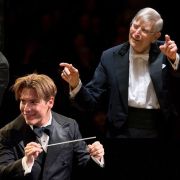
In this revival, Giacomo Sagripanti conducted the State Opera Orchestra in a vivid, detailed and enthralling interpretation of Puccini’s masterful score. From the agile, fresh opening to the mournful and deeply emotional conclusion, the orchestra illuminated every facet of the lives of these young people, crippled by poverty yet still hungry for life, art and love. The third act was particularly poignant, with orchestral colour perfectly mirroring the visual palette on stage: the blue-grey tones of a cold winter morning, heavy with snow and resignation. The sound was luxuriant, Sagripanti often allowing the orchestra to dominate the performance, at times overpowering both stage action and singers. This imbalance may also have been the result of limited rehearsal time, which could have helped achieve a more finely calibrated balance.


Superstar tenor Juan Diego Flórez, renowned for his bel canto repertoire, assumed the role of Rodolfo for the first time at this venue. Flórez is not especially celebrated for his acting – descriptors such as “wooden” have been applied – but his approach proved well suited to a production like Zeffirelli’s. The iconic, almost fairy-tale quality of the staging, combined with his deep understanding of the character and his naturally youthful physique, lent his portrayal clarity and vividness.

Vocally, there were moments of difficulty in cutting through Sagripanti’s dense orchestral texture; Flórez at times seemed to lack the fullness and sensual weight associated with a true verismo tenor, though this comes as no surprise. The high notes, however, rang out beautifully (and it was a relief to hear the conclusion of “Che gelida manina” in the correct key), while his refined musicality and innate elegance were evident throughout, shaped into beautifully crafted phrasing. His performance was emotionally engaging.
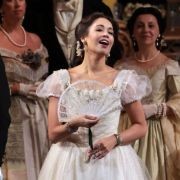
Rodolfo’s beloved Mimì was portrayed by Nicole Car, whose full-bodied soprano endowed the character with considerable emotional depth. Her voice perhaps lacked some of the sweetness and sustained pianissimo traditionally associated with the role, yet it revealed a profound melancholy well suited to Mimì’s fragile nature. She was at her strongest in the more expansive, full-throated passages, where her high notes floated freely, defying even the formidable Vienna brass section. Her interpretation was deeply affecting, culminating in a death scene of great emotional power, marked by some of the most convincingly realistic coughing I have heard. Tears were shed; mission accomplished.


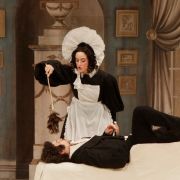
Andrey Zhilikhovsky was a pleasant surprise as Marcello. His smooth baritone was exceptionally well projected and his phrasing consistently elegant. The duet with Flórez, “Ah, Mimì, tu più non torni”, was beautifully shaped and deeply felt. Ivo Stanchev, as the philosopher Colline, offered a tender “Vecchia zimarra,” his bass voice deep and mellow, though with some strain in the upper register. Jusung Gabriel Park sang Schaunard with energy and excellent projection, his well-characterised baritone lending humour and vitality to the role, particularly in his “parrot” scene.
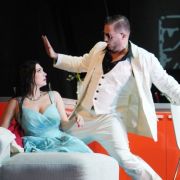
Musetta was sung by Anna Bondarenko, whose soprano was fuller than one usually hears in this role. Her interpretation was spirited, as the character demands, though she proved most compelling in the final act, where her emotional involvement during Mimì’s death was deeply felt. The cast was completed by Hans Peter Kammerer, who took on the dual roles of Benoît, the landlord, and Alcindoro, Musetta’s wealthy, aging suitor. His bright baritone and sharply drawn characterisations were ideally suited to these two comic roles.
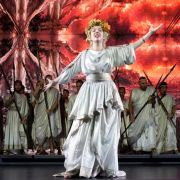
Honourable mention must go to the State Opera Chorus, which vividly brought to life a bustling Parisian Christmas market, infusing the stage with colour, energy and a palpable sense of the holiday season.