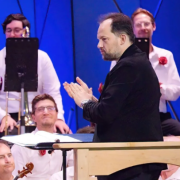
Andris Nelsons’s final appearance at Symphony Hall this season was last week. Yet the orchestra and stage crew chose to express solidarity with him for this week’s program too, and likely for the foreseeable future, by continuing to sport the red flowers adopted after the announcement of Nelsons’s termination. Both guest conductor, Andrey Boreyko, and soloist, Evgeny Kissin, joined them.

Kissin anchored the program, performing two markedly contrasting piano concertos (the original program had him playing three, all Russian): Mozart’s no. 12 and Scriabin’s one and only. The sole link between them, albeit tenuous, is the age at which they were composed, 26 for Mozart; 25 for Scriabin. Boreyko and Kissin had performed the same program sans Lyadov with the Chicago Symphony last week, so there was a sensitive and confident give and take between podium and piano.


Several Mozart scholars have noted that the composer favored the key of A major for expressions of a lyrical, yet tranquil nature. Even so, Kissin chose to trouble the unclouded grace and gentility of the concerto’s first movement with hints of darkness and weight. Phrases often tapered off to a whisper, an oddly arresting effect which lent an unearthly quality to the movement. Long, singing phrases, a steady pulse in the left hand and the ability to simultaneously conjure up a different tonal quality for each hand distinguished a somber, elegiac Andante. The concluding Rondo might otherwise have seemed restrained and subdued if not for what had come before. Kissin performed Mozart’s later version of the four cadenzas.
Scriabin’s Piano Concerto in F sharp minor is challenging, but neither flashy nor thundering with athleticism. It is a poetic inner dialogue marked by turbulence, indecision and uneasy resolve. Angst and yearning tempered by introspection drove the first movement; the second with its theme and variations unfolded like a luminous scene from childhood, its innocence momentarily marred by the ominous rumbling of the third variation. The finale derived much of its impact from Kissin’s restraint in the first two as he let loose with all his rhapsodic power and finesse to express its turmoil and contradictions. Standing ovations have become almost Pavlovian these days. This one was well deserved.


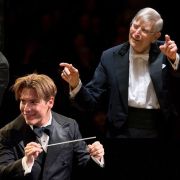
The rest of the program gave Boreyko ample opportunity to shine on his own, leading Lyadov’s colorful vignettes and Rimsky-Korsakov’s Russian Easter Festival Overture. He chose to divide the violins to his left and right with the violas next to the first violins and the cellos alongside the seconds. Several times, he dispensed with the baton to lead a passage. The antiphonal seating created a balance and blend he exploited to distinguish the individual colors required of the various sections and to delineate the music’s flow and dynamic contrast. If the overture, for all its high energy, sonorous chanting, and multicolored tolling, didn’t quite build to the Dionysian intensity of what Rimsky called “the unbridled pagan-religious merrymaking on Easter Sunday morning”, it did end in a sunburst of jubilation.
Lyadov’s brief tone poems sparkled like multi-faceted gems. Nature opened the door to the supernatural in The Enchanted Lake with its hypnotic, shimmering strings and Wagnerian echoes. Baba-Yaga and Kikimora, both an unusual mix of the macabre and the whimsical, drew laughter as they each closed with an impish flourish. All in all a very impressive debut for Boreyko.