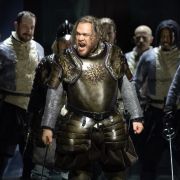
Deborah Warner’s 2013 production of Tchaikovsky’s Eugene Onegin, last seen in New York in 2022, is back at the Metropolitan Opera for its third revival. Her staging, which shifts the action from the 1820s to the late 1870s, the time of the opera’s composition, seems as cramped and claustrophobic as ever.

Tom Pye’s set designs frame the action of the long first act in a drab, workroom-like structure through whose windows we catch glimpses of birch trees and see the Larin family’s servants coming and going about the estate. Ian William Galloway and Finn Ross’ video projections of Russian forests, waterways and wheatfields – used between scenes to establish location and mood – are far more successful at evoking a sense of the vast and varied Russian landscape. Jean Kalman’s lighting designs are another memorable standout, especially near the end of Act 1, where the sunrise bathes Tatiana’s barn-like bedroom in a gorgeous golden glow, and in the second scene of Act 2, where the snowy dueling ground appears exceptionally atmospheric.


For this run, Asmik Grigorian – last seen at the Met in 2024 in her highly acclaimed company debut in Madama Butterfly – heads a strong cast in her company role debut as Tatyana. She has a long history with the character, dating back to 2012 when she first sang the part in her home town of Vilnius, Lithuania. As the introspective ingénue who falls for and is coldly rejected by the world weary Eugene Onegin – who later returns from exile to find her transformed into a self-possessed and principled princess – her performance was a masterclass in psychological evolution and vocal flexibility. In the long and dramatic Letter Scene, her thrilling voice vibrated with first-love intensity, and as the mature Tatyana she was haughty but deeply poignant, her facial expressions revealing a lingering passion for Onegin.

Iurii Samoilov was elegant and charismatic, both vocally and dramatically, as Onegin. As the urbane aristocrat, who realizes his affection for Tatyana far too late, the Ukrainian baritone displayed a vibrant and robust voice, conveying his complex character’s evolution – from detached arrogance to fiery passion and despair – with admirable skill and musicality,
French tenor Stanislas de Barbeyrac’s Lensky seemed overly subdued in Act 1 as he declared his love for Olga, Tatyana’s younger sister. However, as the evening progressed, his vocal command improved significantly. During the Act 2 party scene for Tatyana’s name day, his voice seemed more confident, and the notes in his upper register effortlessly rang out. Before the duel with Onegin, his richly lyrical rendition of “Kuda, Kuda” effectively communicated his character’s internal pain as he faced his mortality.


As Olga, Russian mezzo-soprano Maria Barakova was bright and clear voiced, endowing the character with a charming sense of grace and playfulness, and serving as a foil to her more introspective sibling. Ukrainian bass-baritone Alexander Tsymbalyuk made a strong impression in his brief appearance as Prince Gremin, the aristocratic retired general who marries Tatyana after she has been rejected by Onegin. His Act 3 aria, in which he describes his happiness, was one of the most moving and memorable moments of the evening.

Most of the other cast members were reprising roles they embodied in the 2022 revival. Mezzo Elena Zaremba as the widowed Madama Larina sang with a rich, full voice. Tenor Tony Stevenson was delightful in his cameo as Monsieur Triquet. Mezzo Larissa Diadkova offered a fully formed character as Filippyevna, the family’s old nursemaid, and bass Richard Bernstein was surprisingly assertive and commanding in his limited stage time as Zaretsky, Lensky’s second in the fatal duel.

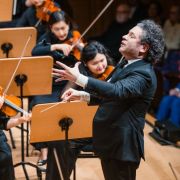
In his Met Opera debut, young Russian conductor Timur Zangiev elicited an exciting and dramatic account of Tchaikovsky’s lushly lyrical score from the Met Orchestra. Especially memorable were the overlapping woodwinds in the Letter Scene and sounds of the French horn in both that scene and the devastating final act. The singing of the Met Chorus, directed by Tilman Michael, was magnificent throughout.