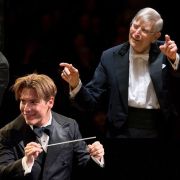
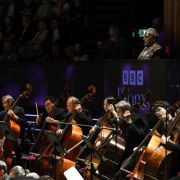
Back in 2007, Vladimir Jurowski opened his tenure as the London Philharmonic Orchestra’s Principal Conductor with Das klagende Lied, Mahler’s first large-scale work of note. Together, conductor and orchestra have worked their way chronologically through an output which unfolds like an autobiographical novel, a dance to the music of time. Saturday night’s performance of the Tenth Symphony thus brought to a close a 20-year cycle in the making, and did so in satisfyingly momentous fashion.

A large Mahler symphony requires no introduction in concert. Audiences and musicians alike, however, benefit from a period of throat-clearing, intellectual as well as physiological, before the main event. The long viola line to open the symphony suffered two phone alarms, four large coughs and several small ensemble slips. My heart went out to the production staff for LPO Live, who had laid out their microphones with a view to commercial release: one hopes they had a back-up take in the can.


Once bedded in, Jurowski’s smooth and steady pulse presented this long Adagio as a natural sequel to the finale of Mahler’s Ninth, but also as a successor to the broad initial unfolding of Bruckner’s Ninth, and a precursor to those enigmatically titled Moderato movements opening several Shostakovich symphonies. As well as divided violins and sensitively moulded, echt-Viennese portamento throughout the strings, the germane factor at play, in this projection of the Tenth within the symphonic canon, was Jurowski’s unusual choice to eschew the standard completion by Deryck Cooke, and turn instead to the richer, more elaborated textures of Rudolf Barshai’s edition.
Barshai throws the kitchen sink at the Tenth’s pair of Scherzos, and this kept an eight-strong team of percussionists busy as well as two timpanists. At moments such as a woodblock solo, anachronistically filling a gap in the first Scherzo with a rattle straight out of 1930s Shostakovich, it seems inconceivable that Mahler would have done the same. But so what? The task undertaken by Cooke, and then Barshai after his example, was to make performable (and “Mahlerian”) a work which, even in the sketchy state left to us, shows the 50-year-old composer at the peak of his powers, still evolving the symphonic form and learning from himself and his predecessors.
However carefully balanced by Jurowski, Barshai’s punctuating bangs and crashes could not paper over the cracks in the second Scherzo, which remains thin and banal to a degree unsalveagable either by assorted editors or by the dubious projection of Mahler as an ironist-modernist. Much more convincing was the short, central Purgatorio as the instrumental translation of Mahler’s song Das irdische Leben, and Jurowski’s dovetailing of it with the second Scherzo.


When this in turn led directly to the finale via the offstage thwacks of a bass drum, life came face to face with art. At work on the piece in a New York hotel room, Mahler had been initially distracted and then inspired by the marching-band obsequies for a late fireman down in the street below. The lugubrious tread of the finale’s introduction felt perfectly paced, both in itself and as preparation for the unearthly consolation of Juliette Bausor’s flute solo. Where Cooke is scrupulous but sometimes skeletal, Barshai’s in-fill serves to evoke earlier Mahler marches and finales without anything so crass as direct quotation. Only at the last sigh, or so it seemed on Saturday, does the symphony acknowledge sentiment, as the last musical testament of the last Viennese symphonist, and there are worse epitaphs.