New York City Ballet has put together a generous, exciting Contemporary Choreography I program featuring two new ballets that premiered the previous evening at the Fall Fashion Gala. I caught the opening night performance.

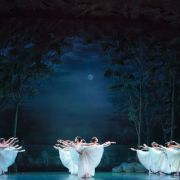
The program opened with Justin Peck’s Pulcinella Variations, another fashion gala creation from several years back. Pulcinella is a good, not great, Peck ballet. I find the first pas de deux somewhat bland, though Emily Kitka and Gilbert Bolden III danced it ably here. The costumes are overindulgent and generally feel disconnected from the dance. But the solo variations are inspired and the ballet builds through them to a stronger second pas de deux, danced by Tiler Peck (who originated the role) and Roman Mejia (in a debut), and a satisfying finale. In the variations, KJ Takahashi and Jules Mabie, each of whom danced featured roles in multiple ballets on this program, were both excellent and Indiana Woodward was a marvel – fleet-footed and bright, in the role she originated.


Next were the two new ballets, Auspicy by Alysa Pires and Shared Rain by Jennifer Archibald. I have not seen Pires’ first ballet for the company, Standard Deviation, which premiered to mixed reviews. I found Auspicy stylish and quite moving. Though there is no narrative in the program to accompany this ballet, its roles have titles that suggest a story. There is a Mother, two Offspring, two members of the Community and a corps of Fledgings. The curtain opens to a large Mother-shaped structure, maybe ten or twelve feet tall, from whose feathered skirt emerges first the two Offspring, the charming virtuoso pair of Emma Von Enck and David Gabriel, then the Fledglings. Shortly thereafter the structure recedes and is replaced by the Mother herself, an authoritative Unity Phelan.

The first half of Auspicy belongs to the Offspring and the Fledglings, who flit about the stage in various groups and formations. I imagined the Fledglings to also be offspring of the Mother, though perhaps younger than the leading pair of Von Enck and Gabriel. Their movements were stylized and peculiar, yet harmonious. Imagine something like Jerome Robbins’ The Cage but warm and earnest and about birds. When the Mother is onstage in the first half of the ballet, she is a supportive, quiet presence, looking after the Offspring and the Fledglings while wearing a heavy costume made of woven, golden strips of fabric, with the word ‘PROTECT’ wrapped around her shoulders in large, bold letters. The costume is too restrictive to really move in, and the Mother mostly just walks in this part, save for one arabesque supported by her two gracious Community members, Gilbert Bolden III and Preston Chamblee.

In the second half, though, the Mother transforms. There is a beautiful tableau where, surrounded by the Fledglings, she removes two long feathers from her body and affixes them to her Offspring, as if securing their wings. Then she sheds the rest of her feathers too, removing her heavy costume to reveal a plain brown dress. And finally, she begins to dance, unsteadily at first as she tests her unburdened legs. Phelan is lovely and open-hearted in the variation that follows, once again supported, yet never overwhelmed, by the Community. This series of events is open to interpretation. I read it as the Mother, having sent her children off into the world with unique gifts, rediscovering a part of herself that had lain dormant. She has danced before and now, after some time, she dances again. Eventually, she is rejoined onstage by the Offspring and the Fledglings (now in matching feathers of their own) and all embrace the new version of their matriarch.


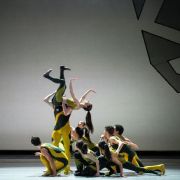
Shared Rain, a fourteen-minute burst of energy, is Jennifer Archibald's first work for New York City Ballet. It opens in a storm, with the dancers wearing head-pieces that look like umbrellas, and the ballet takes off from there, fast-paced and dynamic from start to finish. Archibald makes excellent use of her eight-dancer cast, finding moments to show off each dancer’s unique skills within a cohesive whole. Ruby Lister, Victor Abreu, KJ Takahashi, and Maya Milić were all tremendous in this piece. And I particularly enjoyed the pairing of Takahashi and Milić, who I had not seen dance together previously.
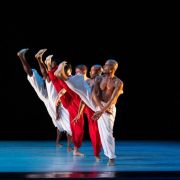
The program concluded with Kyle Abraham’s visionary Love Letter on Shuffle, which I could watch over and over again. Abraham is a contemporary choreographer who really understands what City Ballet dancers can do; the two excellent ballets he has created for NYCB are not enough. Love Letter opens with an entrancing, introspective solo danced by Taylor Stanley and features a series of vignettes for a trio and three couples (including Stanley paired with Jules Mabie). Emily Kitka, in a role she originated, and Owen Flacke, in a debut, were particularly affecting. See this program if you can.