The musical history of the 20th century is littered with the rusting hulks of once brave experiments – neoclassicism, serialism, aleatory – yet one of the many austere attempts to break free from the Austro-Germanic classical straightjacket survives and thrives. Steve Reich takes minimalism and uses it to make music. His sound world of overlapping polyrhythmic structures, layer upon layer, is as difficult to penetrate to its core as it is easy to listen to, waves of sound enclosing underlying layers of meaning.

Magnificent though the BBC Scottish Symphony Orchestra was, no-one got closer to the meaning beneath the notes than guitarist Bryce Dessner. Electric Counterpoint, written for the Jazz-fusion legend Pat Metheny, places the guitarist alone on stage accompanied by a pre-recorded track of up to 11 guitars and two basses. Dessner was a humble, devotional presence, the sweet illuminating sound of his Gibson Les Paul Standard alternately soaring over the texture then burying deep within the complex counterpoint of the recording. This was playing of great beauty and understanding.


Three Movements, which began the evening, was perhaps the least successful. It made its point forcefully, repeatedly, but presented as an exercise in communicating the complexity of the multiple rhythms more than a conversation – which is what this music has to be if it is to work. It is just about possible for an audience to listen to some classical era pieces superficially, but Reich’s music (like Beethoven’s, whose music and in particular structural management I increasingly caught echoes of through the evening) demands total engagement.

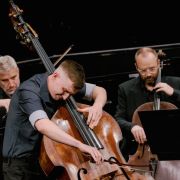
By the time we reached the Variations for Winds, String and Keyboards, Colin Currie and the orchestra had it. In this earlier work Reich was already exploring the idea of using orchestral sections in counterpoint with each other and it is a gripping piece, holding the attention throughout its twenty minute duration. Strings were alternately ethereal and brutal, percussion played with unerring precision, and above all this a long line of winds played as one polychromatic instrument, shimmering, coruscating and tender.
The Four Sections for full orchestra is a vast canvas, expanding on many of the ideas first used in the Variations. But its crucial quality is that of its more audible subtext; this is nothing short of the whole, glorious, tragic spread of America in 25 magnificent minutes. From the distant rumble of a freight train via the soughing of a lone windmill in a 40 square mile cornfield to the thump of diesel on the highway, this was infused with all the optimism and tragedy that America can encompass.


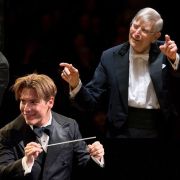
As a musician, I would feel both safe and inspired by conductor Colin Currie. His understanding and joy in the music is audible, visible, and the accuracy of his direction faultless. His generosity to players mirrored the generosity of this remarkable music, a unique exposition of a significant living composer in one joyous evening.