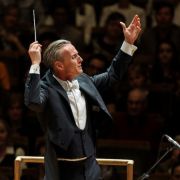
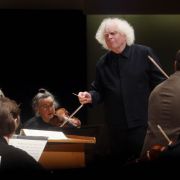
Composed months before her untimely death, Lili Boulanger’s D’un soir triste is a complex, darkly introspective work whose emotional depths seem to foreshadow her own passing. Conducting the National Symphony Orchestra Ireland, Anna Sułkowska-Migoń paid meticulous attention to every detail of the score, patiently building tension to its angst-filled climax. She relished the kaleidoscope of colours: ethereal harp and celesta textures and a haunted, muted tuba lurking beneath the surface. The explosion of dissonance at the climax was terrifying and even after the pianissimo ending, the tension still hovered in the air.


Shostakovich spent much of his life under the forbidding scrutiny of Soviet authorities, but his Piano Concerto no. 1 in C minor predates that pressure and is imbued with a mischievous, experimental spirit.
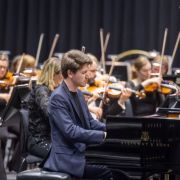
The trumpet’s role playful but distinctly secondary, although that did not stop Darren Moore from poking fun with cheeky, pointed interjections as pianist Barry Douglas dispatched his virtuoso passagework – driving rhythms and furious octaves – with muscular authority. It was a question of spot-the-quotation too, as Shostakovich peppers the score with sly nods to Rossini, Beethoven, Haydn and Tchaikovsky.
The central Lento movement offered well-deserved moments of reflection with its hushed strings, the muted trumpet sounding as if it was coming from far away. Sułkowska-Migoń elicited an electrifying pianissimo from the NSOI. Fiery pianistic exchanges were punctuated by the trumpet’s irreverent asides before Douglas tore into the closing pages, accelerating through zany chords to a blaze of irrepressible C major.
After the relative novelties of the first half, the audience returned to the familiar sound world of Rimsky-Korsakov’s Scheherazade. What really stood out was Sułkowska-Migoń’s masterful control of the dynamics: crescendos snarled, sforzandos cracked like whips. Early tuning lapses in the woodwinds briefly dulled the sheen and violins in their febrile excitement sounded slightly scratchy but there was no doubting the raw authenticity of this performance.


Yet even as the music bubbled and roared, Sułkowska-Migoń stayed aloof from this maelstrom of emotion, allowing her to shape each phrase, every pulsing crescendo. The lugubrious bass lines of trombone and tuba conveyed the Sultan’s menace with ferocious weight. Leader Elaine Clark spun Scheherazade’s violin solos with silky lyricism, while later, she attacked her double-stops with visceral ferocity. Tremolandos in the second movement shimmered with a ghostly glow, the softest pizzicatos holding the hall spellbound. Sułkowska-Migoń allowed the bassoon free rein in its coquettish phrasing, while the clarinet danced through flirtatious scales. In the finale she held something in reserve, switching effortlessly between nervousness and exuberance; her minimal gestures only heightened the tension, electrifying the NSOI before a coda of beguiling calm.