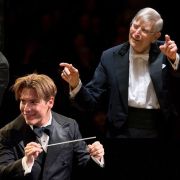
Before the first note, Kazuki Yamada offered a charmingly pointed piece of diplomacy. Acknowledging that 20th-century British music isn't exactly a staple in Germany, he rhetorically asked the audience: since they are a British orchestra, why on earth wouldn't they perform British works here? Tonight the City of Birmingham Symphony Orchestra traded with William Walton, opening the programme with his Orb and Sceptre. Bypassing the usual pomposity, they embraced the work’s rhythmic swing with infectious relish. The march felt lean, agile, and unapologetically stylish, a testament to a "modern" era played with a refreshing, un-stuffy confidence.

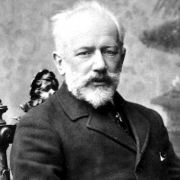
To market a Walton-strong programme, the star power of Bruce Liu was a strategic necessity to fill seats. Yet, the ensuing shift to Tchaikovsky’s First Piano Concerto felt jarring. With a work so familiar, one hardly expects a revelation, but tonight the essential chemistry between soloist and orchestra remained elusive. The first movement, in particular, felt like two distinct emotional entities moving on parallel tracks, each eloquent but rarely intersecting. While Liu’s playing was undeniably focused and poetic, it lacked that inspired spark that transforms a warhorse into a revelation. At times, a slightly over-generous use of the pedal dampened the clarity of his projection. It was only with the second movement that these two parallel lines began to converge. The brief Andantino acted as a necessary bridge, and by the third movement, a palpable sense of urgency took hold. Here, Liu began to convey more sparks; there were moments of phrasing so spontaneous they bordered on a Gershwin-esque improvisational flair. His György Ligeti encore further proved his mettle, showcasing a masterful control of timbre and a remarkable three-dimensional sense of musical space.


Those audiences who departed during the interval missed the true heart of the concert. Walton’s Symphony no. 1 in B flat minor is a complex beast – steely, resilient and shot through with a sly, cold-blooded mystery. It is a demanding work that requires the audience to remain sharp and deeply attentive throughout. Yamada led the CBSO through this symphonic forest like a guide who knows the terrain too well to linger; there was no self-indulgent wallowing, only high discipline and a rugged maturity.

In the Allegro assai, the orchestra maintained a steely tension driven by an unwavering willpower and relentless forward momentum. The second movement, Presto, con malizia, was played with biting precision that captured a character both elusive and dangerously volatile. After the haunting, lonely disillusionment of the Andante con malinconia – which evoked the desolate atmosphere of a Yorkshire moor – the finale burst forth with a muscular, defiant grandeur. The CBSO’s mature pacing ensured the work felt like a singular, relentless expedition, finally breaking through the dense canopy into a clearing of hard-won, stoic light, a resolution that felt like a hybrid of late-Sibelian self-restraint and grounded simplicity, leaving the listener with a sense of hard-earned peace and clear-eyed transcendence.
After Walton, there could have been no more ‘British’ encore than Nimrod from Elgar’s Enigma Variations. The sublime performance was masterfully unsentimental, maintaining a fluid tempo that eschewed self-indulgence.


Overall, this concert offered a fascinating experience that the most famous work on the programme left the listener with an indefinable sense of emotional alienation. In contrast, it was Walton’s thorny, complex symphony – a work that demanded the audience's absolute vigilance – that fostered a profound human connection. In the end, it was the ‘difficult’ music that brought us closest together.
This concert was promoted by DK Deutsche Klassik